GHL Meets SEO — Header
[email protected] (828) 358-2389
Support Portal
TL;DR

Six safety-consulting searches were tested across a 15 × 15 grid with a 10-mile radius covering 400 square miles. Five scans returned 100.00 Share of Local Voice; the remaining “OSHA Safety Consultants” scan still reached 99.56 SoLV with ARP 1.00. At this point, the more useful SEO question is not “Can the profile rank inside this grid?” but “How far can we expand the next test before the ranking boundary finally appears?”

HighLevel Local SEO + B2B Safety Consulting

Google Business Profile Report: Safety Consulting in Hickory, NC

This case study looks at an unusually broad local-search footprint for a safety consulting business serving the Hickory, North Carolina market. Instead of comparing one keyword over time, the report tests six separate searches—consulting, OSHA-related, training, job-site, and broader safety terms—across the same large geographic footprint. The result creates a different kind of local SEO problem: when almost every grid point is already green, the next reporting cycle needs to become more demanding rather than simply repeating the same test.

Industry: Safety Consulting Market: Hickory, North Carolina Report Date: August 2026 Focus: Google Business Profile Grid Coverage: 400 sq. mi.
GHL Meets SEO Client Report · Google Business Profile Search Visibility
All Case Studies
Prepared by GHL Meets SEO

Google Business Profile Visibility Report

Six independent Google Maps search-grid snapshots covering safety consulting and training searches across Hickory, North Carolina and the surrounding market.

Industry: Safety Consulting Market: Hickory, North Carolina Grid: 15 × 15 Radius: 10 Miles Coverage: 400 sq. mi.
Search Points / Grid 225
SoLV 100 Scans 5 of 6
Lowest ARP 1.00
Lowest SoLV 99.56
Section 01 · Google Maps Visibility

Six Safety-Consulting Search Grids

These screenshots are not comparisons. Each card represents a different search term. The common settings—15 × 15 grid, 10-mile radius, and 400-square-mile footprint—make it possible to compare how different types of safety-related search intent behave across the same market without claiming one keyword improved from another.

How to read this set: ARP describes the average position where the profile ranked, ATRP reflects performance across the total grid, and Share of Local Voice indicates how often the profile reached positions 1–3. Because these scans use different keywords and two different August dates, they should be interpreted as keyword coverage snapshots, not a chronological ranking test.
Search Term: OSHA Safety Consultants

OSHA Safety Consultants

Aug. 11

This was the only scan that did not return a perfect 100 Share of Local Voice. Even so, the profile held a top-three position across essentially the entire 400-square-mile test area.

15 × 15 Grid 10-Mile Radius 400 sq. mi.
ARP 1.00ATRP 1.09SoLV 99.56
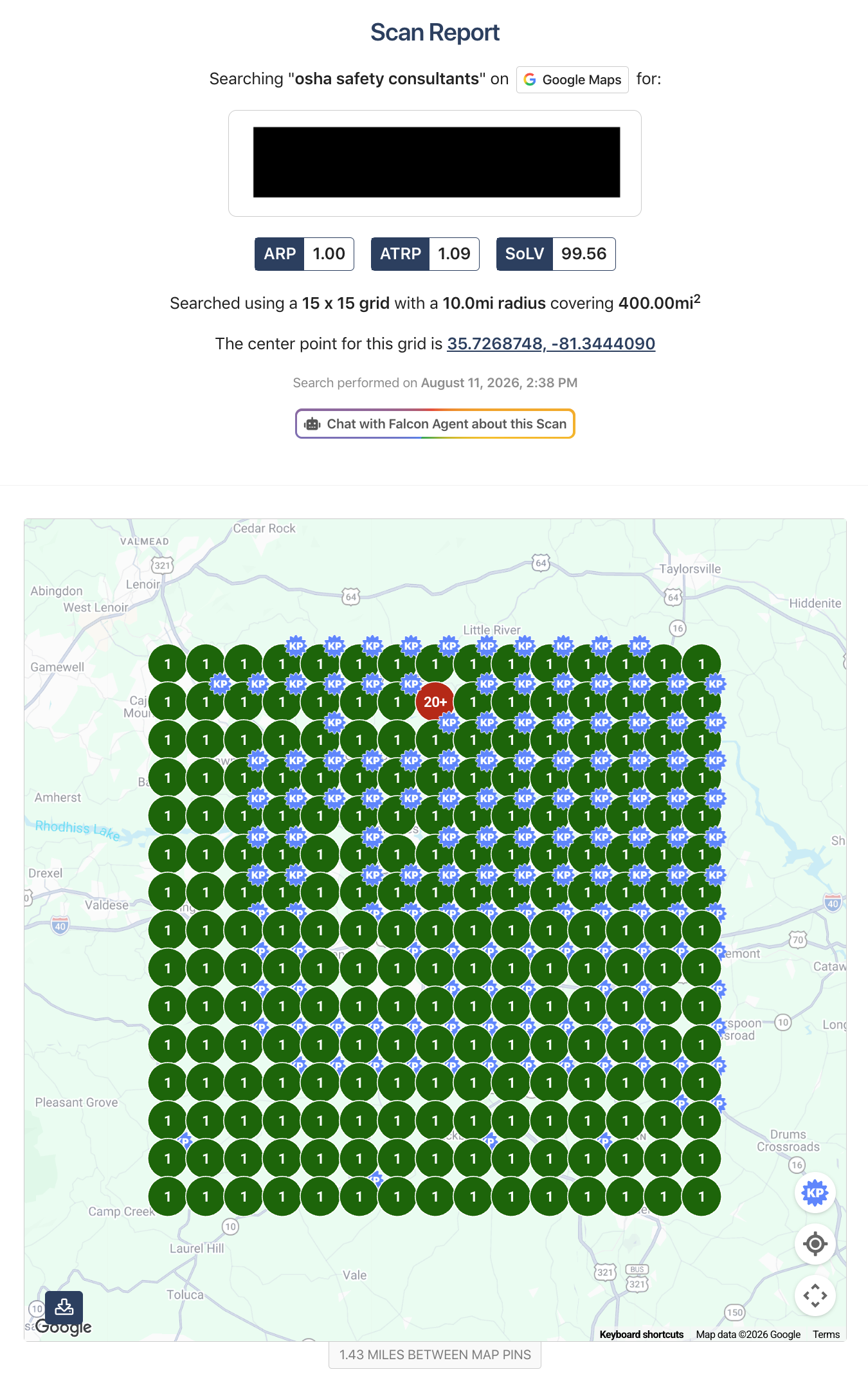
Google Maps search grid for OSHA Safety Consultants near Hickory North Carolina showing ARP 1.00, ATRP 1.09 and Share of Local Voice 99.56 across a 15 by 15 grid with a 10-mile radius.
Search Term: OSHA Safety Consultants
Click to Zoom
Search Term: Hickory Safety Consulting

Hickory Safety Consulting

Aug. 11

A locally modified consulting query produced a complete top-three footprint across the full scan, with the reported average position holding at 1.00.

15 × 15 Grid 10-Mile Radius 400 sq. mi.
ARP 1.00ATRP 1.00SoLV 100.00
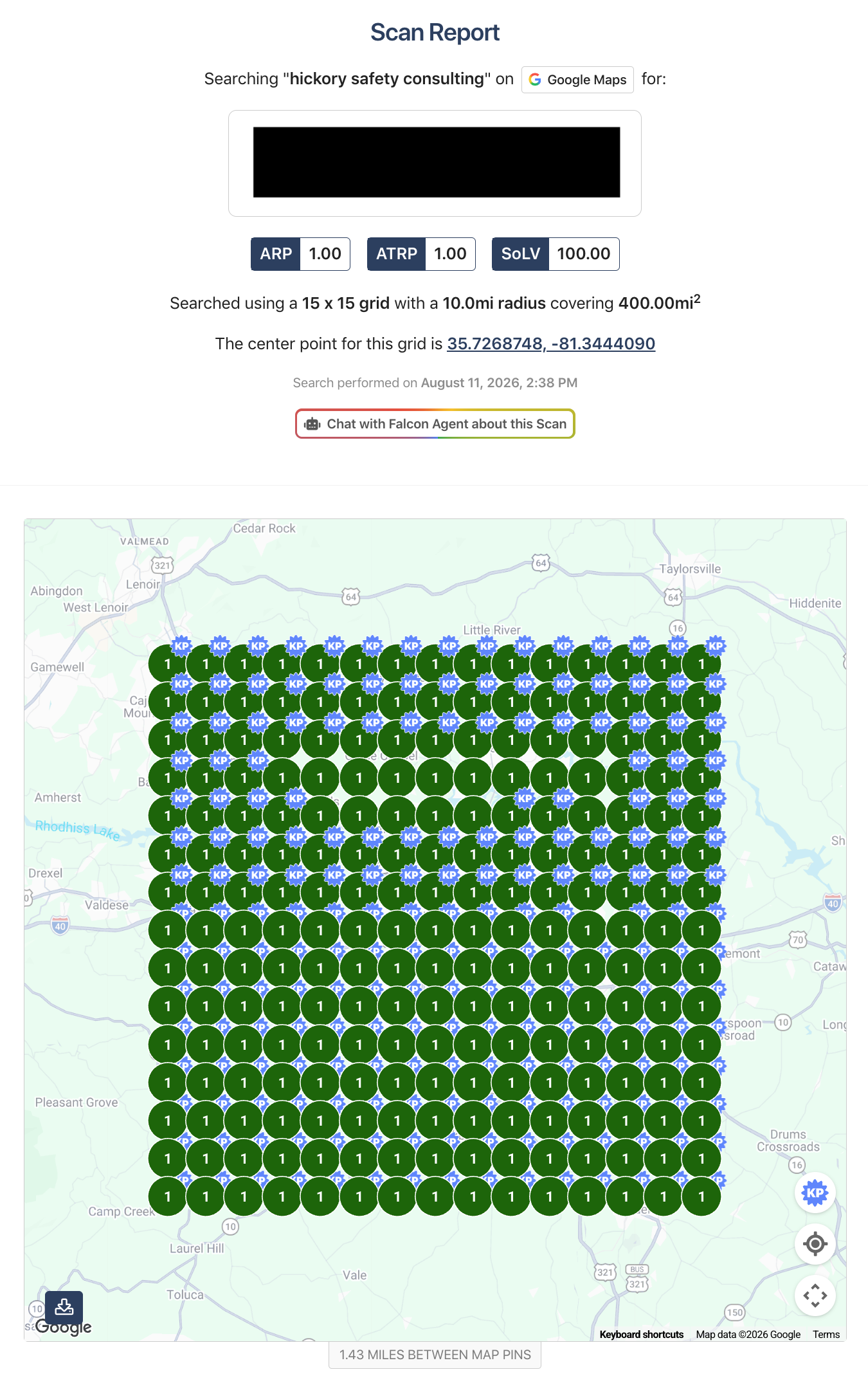
Google Maps search grid for Hickory Safety Consulting showing ARP 1.00, ATRP 1.00 and Share of Local Voice 100 across a 400-square-mile scan.
Search Term: Hickory Safety Consulting
Click to Zoom
What stands out: Across these two 225-point grids, SoLV scores of 99.56 and 100.00 mean 224 of 225 and 225 of 225 tested locations, respectively, reached the top three. The single visible outer outlier in the OSHA Safety Consultants scan is especially useful because it begins to reveal where the current 10-mile test may be approaching a ranking boundary, while the Hickory Safety Consulting scan suggests the next test could expand farther.
Search Term: Workplace Safety Training

Workplace Safety Training

Aug. 11

The training-oriented search performed as strongly as the consulting terms, showing that the profile was visible across more than one kind of safety-related search intent.

15 × 15 Grid 10-Mile Radius 400 sq. mi.
ARP 1.00ATRP 1.00SoLV 100.00
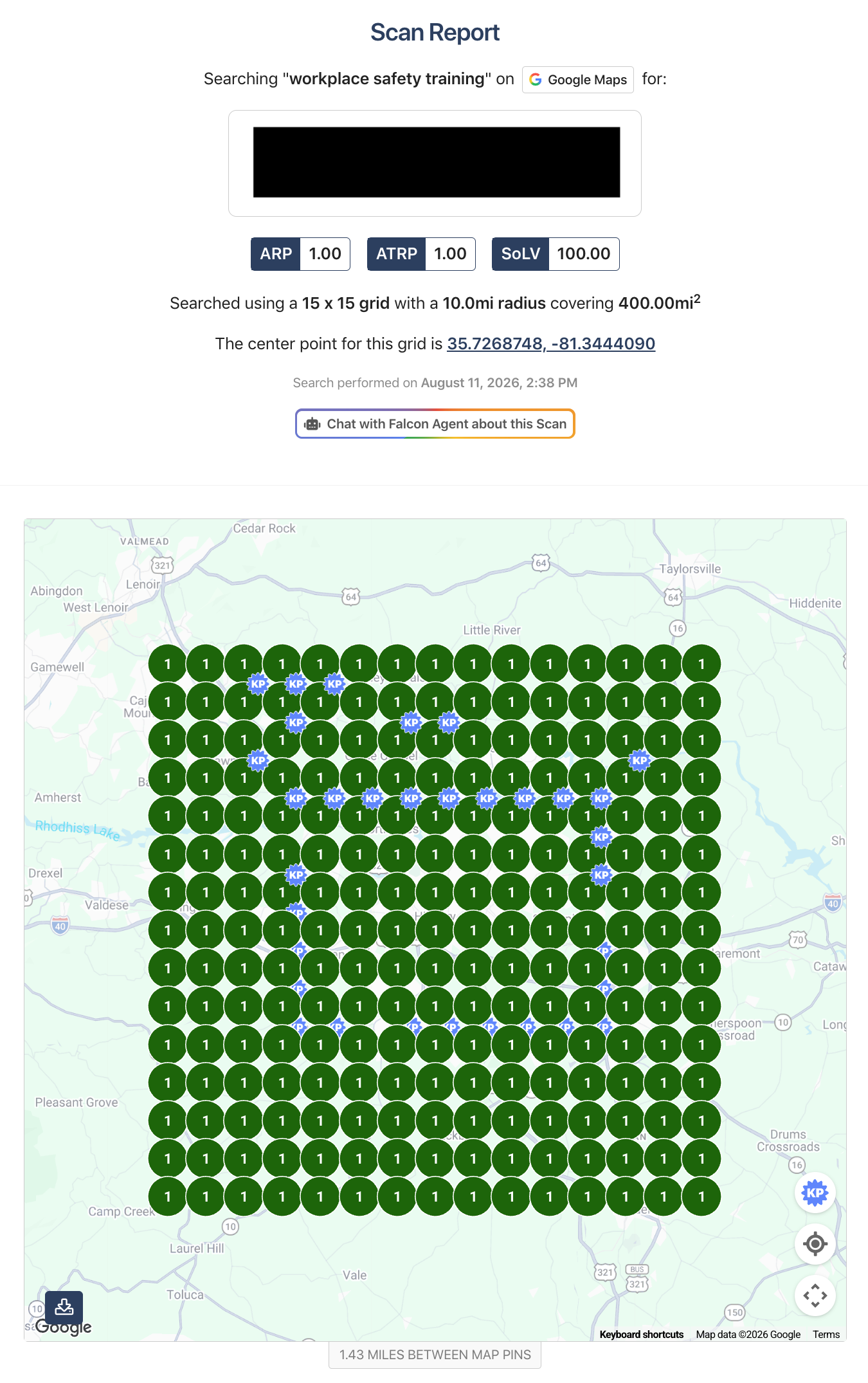
Google Maps search grid for Workplace Safety Training showing top local visibility across a 15 by 15 grid covering 400 square miles around Hickory North Carolina.
Search Term: Workplace Safety Training
Click to Zoom
Search Term: OSHA Safety

OSHA Safety

Aug. 28

This shorter category-style phrase also returned full top-three coverage across the same broad scan footprint.

15 × 15 Grid 10-Mile Radius 400 sq. mi.
ARP 1.00ATRP 1.00SoLV 100.00
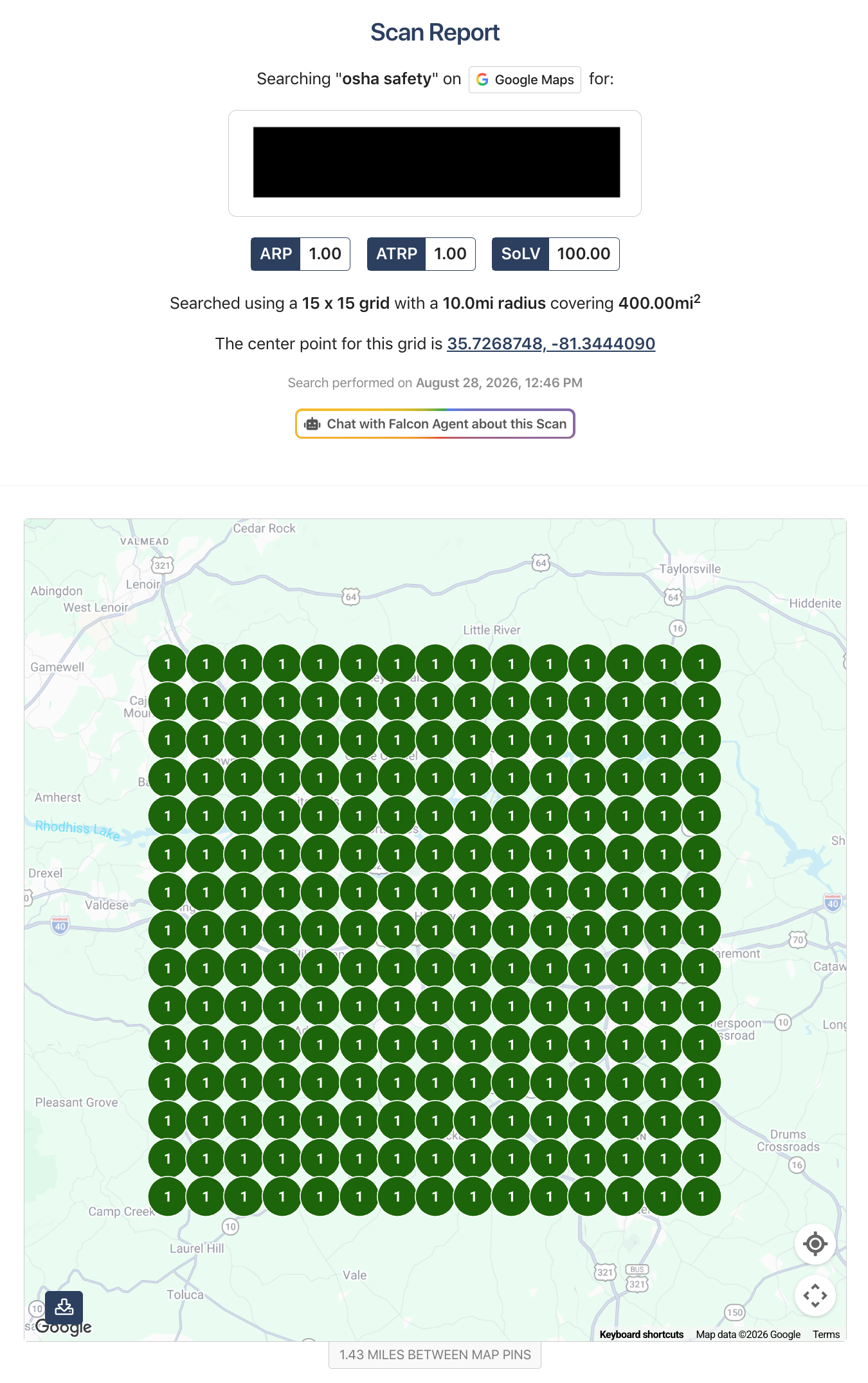
Google Maps search grid for OSHA Safety showing ARP 1.00, ATRP 1.00 and Share of Local Voice 100 across a 10-mile radius.
Search Term: OSHA Safety
Click to Zoom
Search Term: Job Site Safety Consultant

Job Site Safety Consultant

Aug. 28

A job-site-specific consulting phrase produced a complete green grid, adding another specialized commercial intent to the set of searches with broad local visibility.

15 × 15 Grid 10-Mile Radius 400 sq. mi.
ARP 1.00ATRP 1.00SoLV 100.00
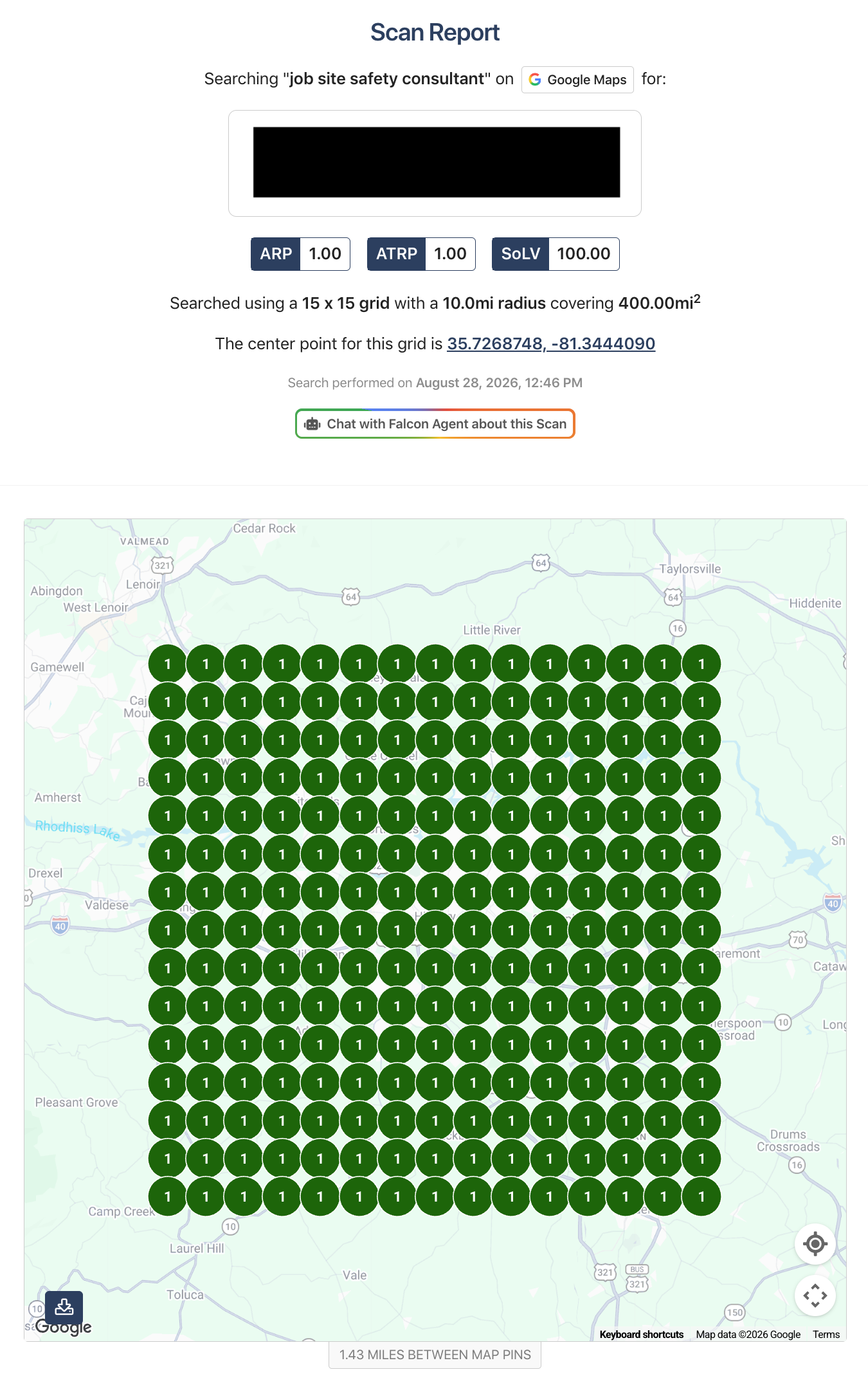
Google Maps search grid for Job Site Safety Consultant showing position-one local visibility throughout a 400-square-mile scan around Hickory North Carolina.
Search Term: Job Site Safety Consultant
Click to Zoom
Search Term: Safety Consultant

Safety Consultant

Aug. 28

Even the broader consultant phrase stayed inside the top three at every tested point. The screenshot shows almost universal position-one coverage with only a small visible variation at the far edge.

15 × 15 Grid 10-Mile Radius 400 sq. mi.
ARP 1.00ATRP 1.00SoLV 100.00
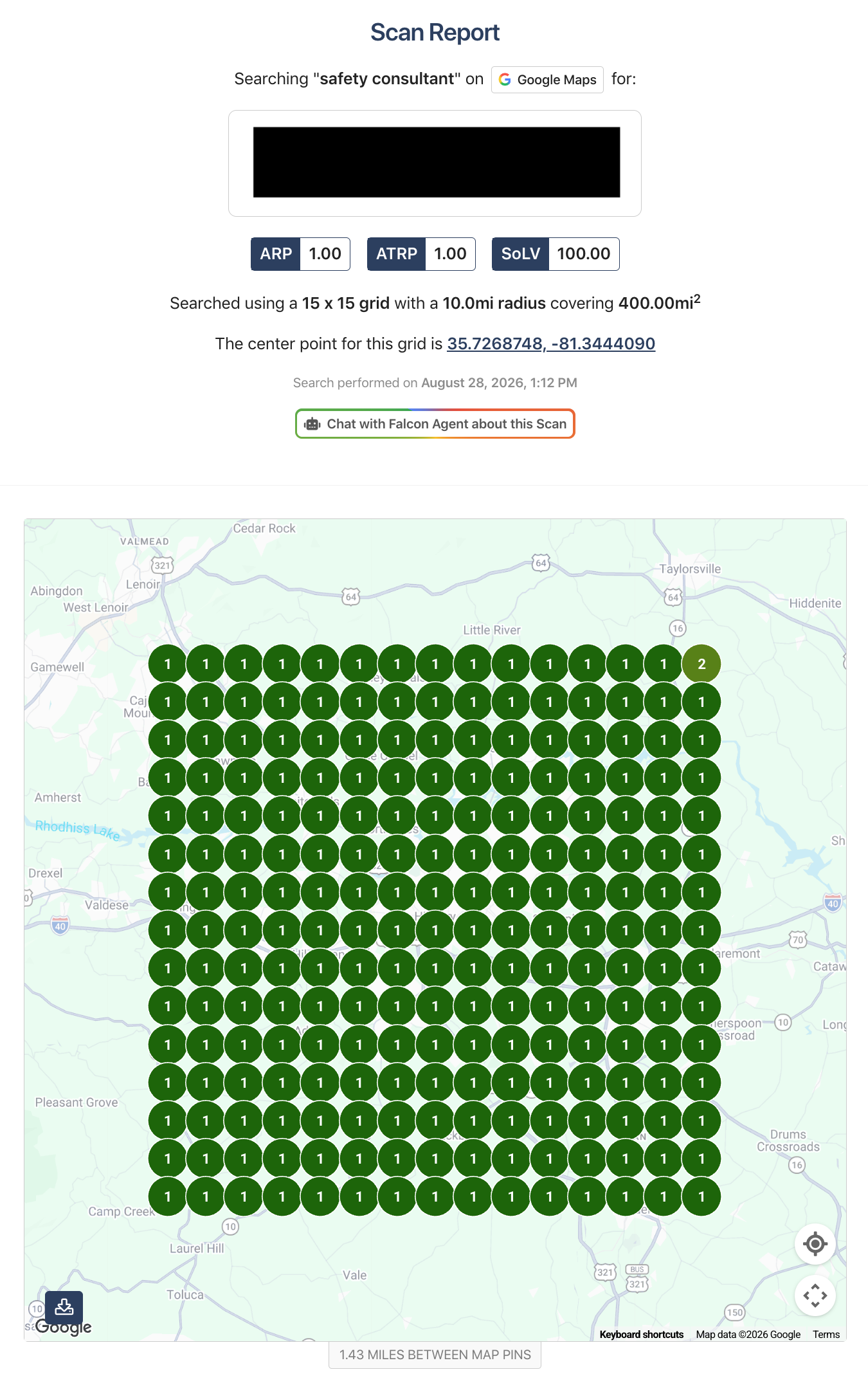
Google Maps search grid for Safety Consultant showing Share of Local Voice 100 across a 15 by 15 grid with a 10-mile radius around Hickory North Carolina.
Search Term: Safety Consultant
Click to Zoom
Section 02 · What the Grid Numbers Represent

From a Search-Grid “1” to the Actual Google Map Pack

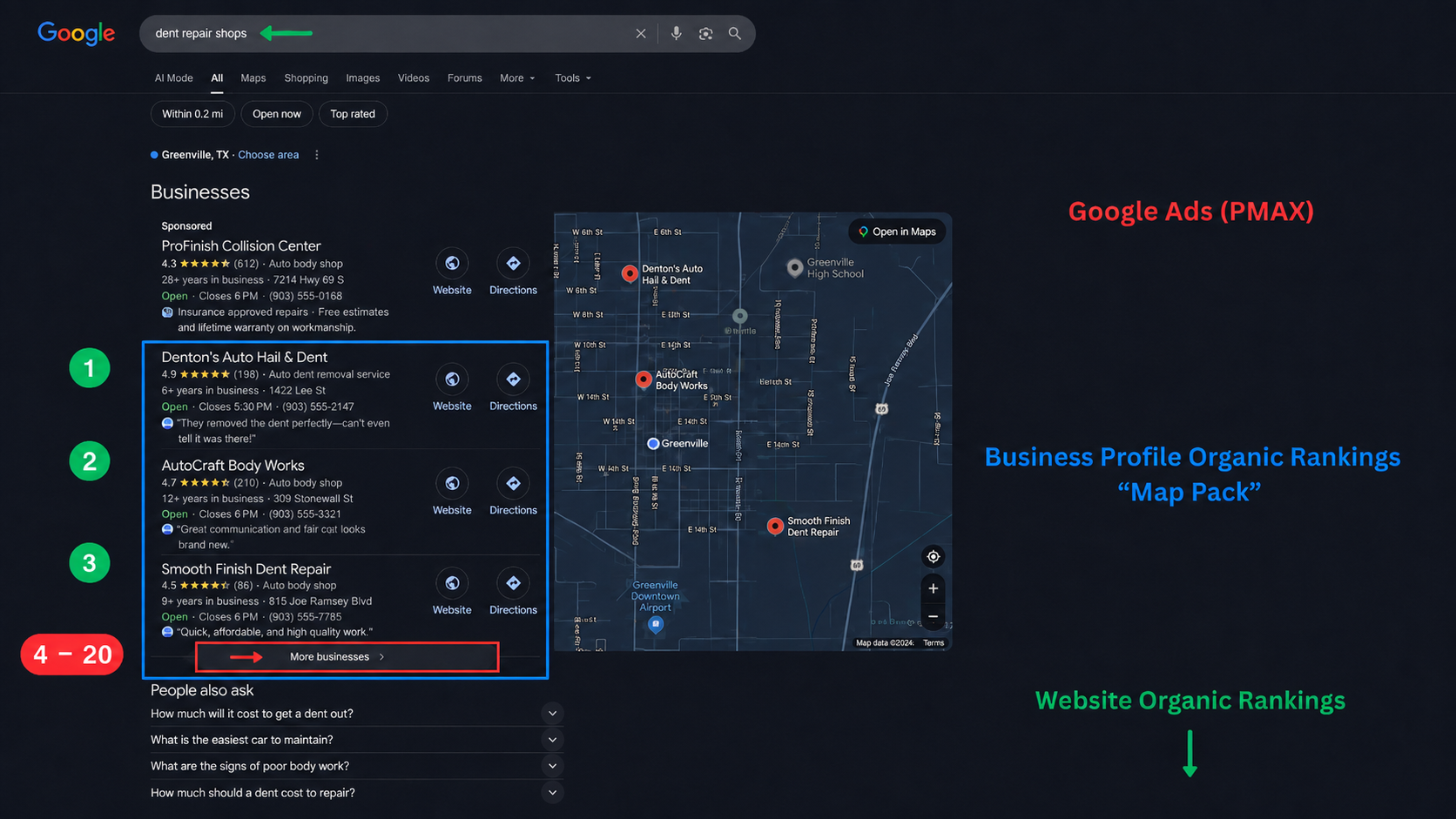
A green “1” means the Google Business Profile was the first organic local listing found for that search from that map point. It does not describe the website's standard organic position and it is separate from paid Google Ads placements.

Why This Matters on an Almost-All-#1 Report

When hundreds of map points return position one, the grid stops being mainly a ranking-improvement chart and becomes a measurement-boundary tool. The agency already knows the profile is highly visible inside the tested footprint; the next useful question is where that visibility begins to weaken outside it.

1–3
Primary Map Pack RangeThese positions represent the top local results most searchers see without opening the larger list of businesses.
4+
Where the Boundary Starts Becoming VisibleYellow, orange, red, or unranked edge points can reveal where proximity, competition, or relevance begins changing the local footprint.
Google Map Pack example showing the difference between paid Google Ads, top three Google Business Profile listings, lower map results and website organic rankings.
Map Pack example: the grid's position numbers refer to Google Business Profile local rankings, not paid ads and not the website's standard organic result.
Report note: All six screenshots use different search terms. Five reached 100.00 Share of Local Voice across the current 400-square-mile scan, so future reports can become more informative by increasing the geographic test area and identifying the first meaningful outer ranking boundary.
Finding the Ranking Boundary

A Wall of Green Is Not the End of the Test

Most local ranking reports are built to find weak coverage. This one creates the opposite problem. With five perfect SoLV scans and a sixth at 99.56, the current 10-mile radius is no longer challenging enough to tell the agency where visibility actually stops.

The Current Grid Has Hit a Measurement Ceiling

Re-running the same 400-square-mile footprint can confirm that rankings remain strong, but it will not reveal much new information if almost every point continues to return position one. A report can be technically accurate and still become less useful when the test is too easy.

The “OSHA Safety Consultants” scan is especially valuable because its 99.56 SoLV leaves one visible weak edge point. That single exception contains more strategic information than another 224 green points: it suggests the profile may finally be approaching the edge of the current local footprint in at least one direction.

Make the Next Scan Harder on Purpose

The next measurement cycle should keep the keyword and center point documented, then expand the radius in controlled steps. If 12 or 15 miles is still almost entirely green, test farther again. The objective is to locate the first consistent ring of positions 4–20 or 20+ rather than chase a larger screenshot for its own sake.

That boundary gives the agency something concrete to work with: the distance where the Google Business Profile stops behaving like a dominant local result and starts competing as an outer-market option.

1
Keep the Search Term FixedUse one revenue-relevant query so a larger radius does not get confused with a completely different keyword.
2
Increase the RadiusExpand beyond 10 miles until the grid begins showing a meaningful outer ring of weaker positions.
3
Mark the First Weak GeographyIdentify towns, corridors, or directions where top-three coverage begins breaking down.
4
Turn the Edge Into a PlanCompare the ranking limit with the company's real service area before deciding where content or local relevance work should expand.
Specialized B2B Search Geography

Safety Consulting Can Behave Like a Regional Service, Not a Neighborhood Service

A 400-square-mile local grid is large for many consumer service categories. For a specialized B2B consultant, however, that distance may still sit well inside the practical market the business serves.

The Buyer May Be Willing to Search Farther

A facility manager looking for workplace safety training or a contractor needing job-site safety consulting may not choose a provider the same way a homeowner chooses the nearest emergency plumber. Specialized expertise, credentials, scheduling, industry experience, and the ability to travel to a facility or job site can matter as much as being a few miles closer.

That does not remove proximity from Google's local algorithm. It simply means the natural service market can be wider, which makes a broader ranking footprint more plausible than it would be for a hyperlocal walk-in business.

A Smaller Relevant Provider Pool Can Change the Map

The screenshots do not prove why this profile ranks so broadly, but specialized categories can have fewer directly relevant competitors than crowded home-service markets. If fewer businesses strongly match a query such as “job site safety consultant,” Google has a different competitive set to work with than it does for a generic high-volume category.

For HighLevel local SEO reporting, this is an important reminder: a 10-mile radius does not have the same difficulty level in every industry. Grid size should be chosen based on the market being tested, not copied mechanically from one client to the next.

Keyword Architecture for Safety Services

Six Green Grids Still Represent Different Reasons to Search

Strong rankings across all six terms should not tempt an agency to treat them as interchangeable synonyms. The query set points to several buyer intents that can deserve different pages, proof, and calls to action if they match services the company actually provides.

Compliance / OSHA Intent

“OSHA Safety Consultants” + “OSHA Safety”

These searches may come from buyers looking for OSHA-oriented guidance, compliance support, or safety expertise. Content should answer the compliance problem clearly without implying an affiliation or service the company does not actually offer.

Consulting Intent

“Safety Consultant” + “Job Site Safety Consultant”

These phrases point more directly toward advisory work. A useful service page can explain where consulting happens, what types of sites are served, what an engagement covers, and how a company begins the process.

Training + Local Intent

“Workplace Safety Training” + “Hickory Safety Consulting”

One term is training-specific while the other adds a geographic modifier. Together they show why HighLevel SEO for safety consulting should connect service-specific content with real local coverage instead of forcing every query onto one generic “safety” page.

The local grid tells us the profile is visible for these searches. It does not tell us whether the website has the best landing experience for each intent. That is where page architecture becomes useful: a visitor searching for workplace training may need different information than a construction manager searching for an on-site consultant, even when both searches currently trigger the same Google Business Profile.

From Ranking Edge to Content Map

Use the First Weak Ring to Decide Where Geographic Content Should Begin

Expanding the grid is not only a reporting exercise. Once weaker outer locations appear, those areas can be compared with the company's actual travel radius and used to prioritize the next layer of local website content.

Build for Real Service Areas, Not for Every City on the Map

If the business routinely serves facilities, contractors, or employers in a nearby city where the expanded grid begins weakening, that location may justify a dedicated service-area page. The page should provide something locally useful: the services available there, how on-site work is delivered, relevant industries served, travel or scheduling context, nearby proof, and map information that helps a prospective customer understand coverage.

The goal is not to publish dozens of interchangeable city pages. A service-area page should exist because the business genuinely works there and because the page can answer location-specific questions better than a generic statewide paragraph.

Re-Test the Geography After the Site Expands

After meaningful website and local relevance work has had time to be crawled, indexed, and evaluated, the same outer-market search can be scanned again with documented settings. If rankings change, the agency has a new observation to investigate. If they do not, the result is still useful because it prevents the team from assuming content alone controls the Map Pack.

Proximity, competitors, reviews, prominence, citations, business information, and other local signals continue to matter. Geographic content supports the broader system; it does not manufacture guaranteed rankings at a distance.

Practical agency rule: When a 10-mile grid is already almost entirely position one, do not use the report as an excuse to stop. Use it to choose a more informative measurement: a larger radius, a harder service term, or a clearly defined outer market the business wants to grow into.
Agency Reporting After a Strong Result

The Best Follow-Up to a Perfect Grid Is a Harder Question

An all-green screenshot is excellent proof for a client once. Repeating the same screenshot indefinitely is not a strategy. Strong reporting should evolve as the account becomes harder to measure inside the original test.

For Retention: Explain Why the Test Is Changing

A client may wonder why the next report suddenly uses a wider radius and contains more yellow or red. The agency should frame that change correctly: the previous grid became too easy. A broader test is not evidence that performance got worse; it is a deliberate attempt to find the edge of a footprint that the smaller grid could no longer measure.

For Sales: Show the Discipline Behind the Screenshot

The useful proof is not simply “look at all these green circles.” It is the method behind them: multiple revenue-relevant searches, a documented grid size, a known radius, an explanation of what SoLV means, and a plan for making the next test more demanding. That reporting discipline can be more persuasive to a prospect than a single perfect screenshot with no context.

HighLevel SEO for safety consultants: The CRM or website platform does not create a 400-square-mile local footprint by itself. HighLevel can support the website, service pages, service-area architecture, internal linking, schema, conversion paths, and ongoing content system around the campaign. The Google Business Profile still competes inside Google's local ecosystem, where proximity and off-site signals remain part of the result.
Hickory Safety Consulting FAQ

What Agencies Should Ask After a Grid Hits Its Ceiling

These answers focus on what becomes important after the original scan area is already saturated with top-three visibility: testing farther, separating service intent, and turning geographic limits into better reporting and content decisions.

If five of six scans already show 100 Share of Local Voice, is there anything left to measure?

Yes. A perfect score inside the current grid tells you the profile is strong within that test area; it does not tell you where the strength ends. The next useful measurement is usually a larger radius or a more difficult, revenue-relevant query so the report can locate the ranking boundary instead of repeatedly confirming the same ceiling.

What does 99.56 Share of Local Voice mean on a 15 × 15 grid?

A 15 × 15 grid contains 225 search points. A SoLV score of 99.56 corresponds to 224 of those 225 points reaching positions one through three. In this report, that makes the single weaker outer point more informative than the large field of green points because it hints at where distance may begin to matter.

Why can a safety consulting business rank across a larger area than some home-service businesses?

Specialized B2B services can have a different competitive geography. Buyers may be willing to hire a consultant or trainer from farther away, the relevant provider pool can be smaller, and the business may naturally serve multiple counties or job sites. Those factors can contribute to broader visibility, although Google still evaluates proximity, relevance, prominence, competition, and other local signals.

Should Workplace Safety Training and Safety Consultant be treated as the same keyword intent?

Not automatically. One phrase is training-oriented while the other is consultant-oriented. If the business genuinely offers both, the website should make those distinct services easy for Google and prospective customers to understand instead of treating every safety phrase as interchangeable wording on one generic page.

How can an expanded search grid help choose future service-area content?

Once a larger grid begins showing weaker rankings around specific edges, the agency can compare those locations with the company’s real service territory. Areas the business actually serves can then be evaluated for useful city or service-area pages, stronger internal linking, locally specific proof, map context, and supporting content. A page should exist because it helps a real customer in a real market, not merely to manufacture a location keyword.

Does an all-green Google Maps grid prove the campaign is generating leads?

No. The grid measures local visibility, not calls, forms, appointments, training bookings, consulting engagements, or revenue. Those business outcomes need separate tracking. The value of the grid is that it shows where the Google Business Profile is being surfaced for specific searches.

What should a HighLevel agency show a client after a grid reaches its measurement ceiling?

Show a harder test. Expand the radius, add another meaningful service-intent query, or compare the ranking boundary with the company’s real service territory. That creates a more useful client conversation than presenting the same all-green screenshot every month and calling it progress.

Turn Strong Local Coverage Into a Smarter Expansion Plan

Browse additional GHL Meets SEO case studies to see how the reporting question changes from one market to the next—from fixing weak visibility, to scaling paid acquisition, to finding the outer edge of a Google Business Profile that already dominates its original scan area.