GHL Meets SEO — Header
[email protected] (828) 358-2389
Support Portal
HighLevel Local SEO Case Study

Google Business Profile Report: Dent Repair Local SEO Case Study

This case study uses a real, anonymized client report to show how local Google Business Profile visibility changed between May and August 2026. The original client-facing report is preserved first, followed by a deeper agency breakdown of the search-grid data, what the changes mean, and how this type of proof can support HighLevel SEO reporting, client retention, and new sales.

Industry: Dent Repair Report Date: August 2026 Focus: Google Business Profile Organic Rankings Coverage Expanded: 25 → 100 sq. mi.
GHL Meets SEO Anonymized Client Report · Local SEO Search Grid Snapshot
All Case Studies
Prepared by GHL Meets SEO

Google Business Profile Search Grid Report

A simple visibility report showing Google Business Profile search-grid comparisons, additional keyword scans, and how an anonymous dent repair business appears in Google's local map results across the surrounding market.

Industry: Dent Repair Focus: Google Business Profile Organic Rankings Format: Local Search Grid Comparisons
Quick note: The first two sections compare the same keyword across two dates and two different map sizes. Because the later scans use a larger grid and radius, they should be viewed as a broader visibility benchmark rather than a perfectly identical apples-to-apples test.
Section 01

Keyword Comparison Sets

Each pair shows the same keyword across two dates. The later scan also covers a much larger geographic area, allowing us to compare both ranking progress and broader reach.

Dent Repair

This core service keyword is shown across both the earlier local-area scan and the newer expanded search area.
Comparison Keyword Two Dates Expanded Map Coverage
Earlier Scan

Dent Repair
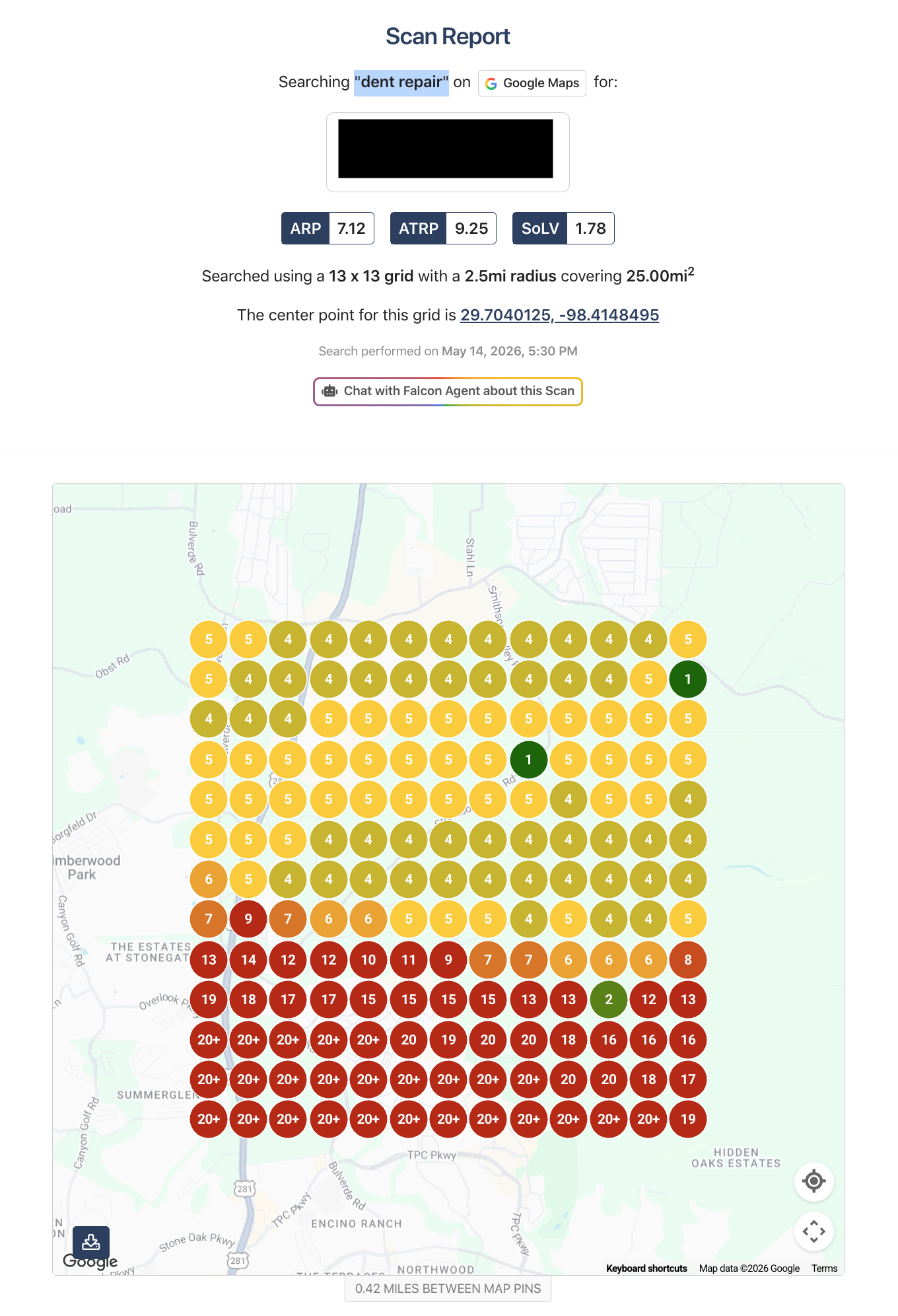
  • Date: May 14, 2026, 5:30 PM
  • Range: 13 × 13 grid with a 2.5-mile radius
  • Coverage: 25.00 square miles
  • Metrics: ARP 7.12 · ATRP 9.25 · SoLV 1.78
Anonymized GHL Meets SEO local SEO search grid for Dent Repair from May 14 2026, using a 13 by 13 Google Maps grid across a 2.5-mile radius and 25-square-mile area, showing mixed local ranking positions from the top three through positions 20 plus.
Map-focused preview
Click to Zoom
Later Scan

Dent Repair
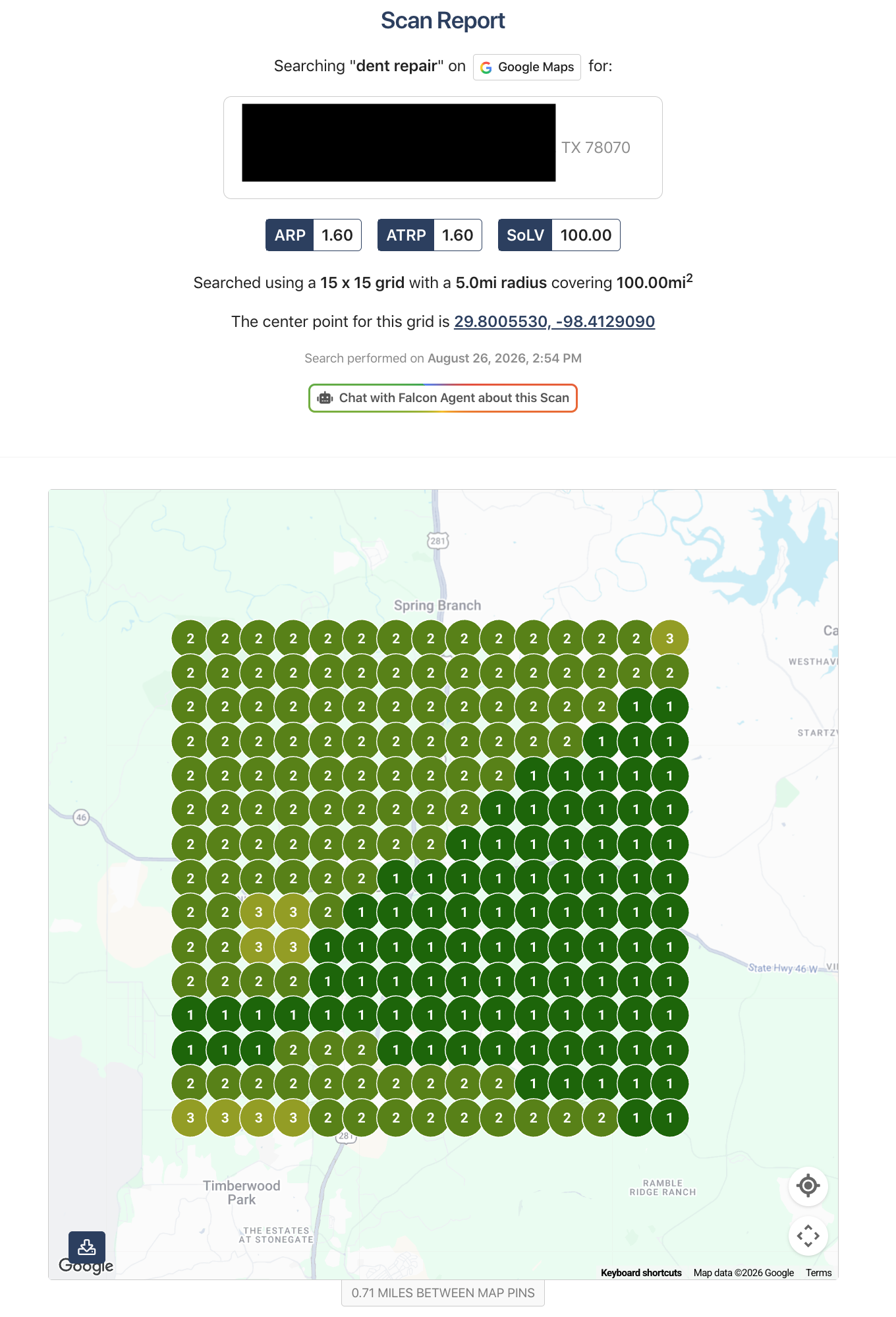
  • Date: August 26, 2026, 2:54 PM
  • Range: 15 × 15 grid with a 5.0-mile radius
  • Coverage: 100.00 square miles
  • Metrics: ARP 1.60 · ATRP 1.60 · SoLV 100.00
Anonymized GHL Meets SEO local SEO search grid for Dent Repair from August 26 2026, using a 15 by 15 Google Maps grid across a 5-mile radius and 100-square-mile area, showing almost entirely number one and number two local ranking positions.
Map-focused preview
Click to Zoom
What This Comparison Shows

The August scan expands from a 13 × 13 grid with a 2.5-mile radius to a 15 × 15 grid with a 5-mile radius. Because the newer scan covers four times the geographic area, it should be used to evaluate broader local reach as well as ranking progress. Even with the expanded test area, the later map is dominated by positions 1 and 2.
Dent Removal Service

This service-intent keyword uses the same before-and-after structure while testing visibility farther away from the business in the newer scan.
Comparison Keyword Two Dates Expanded Map Coverage
Earlier Scan

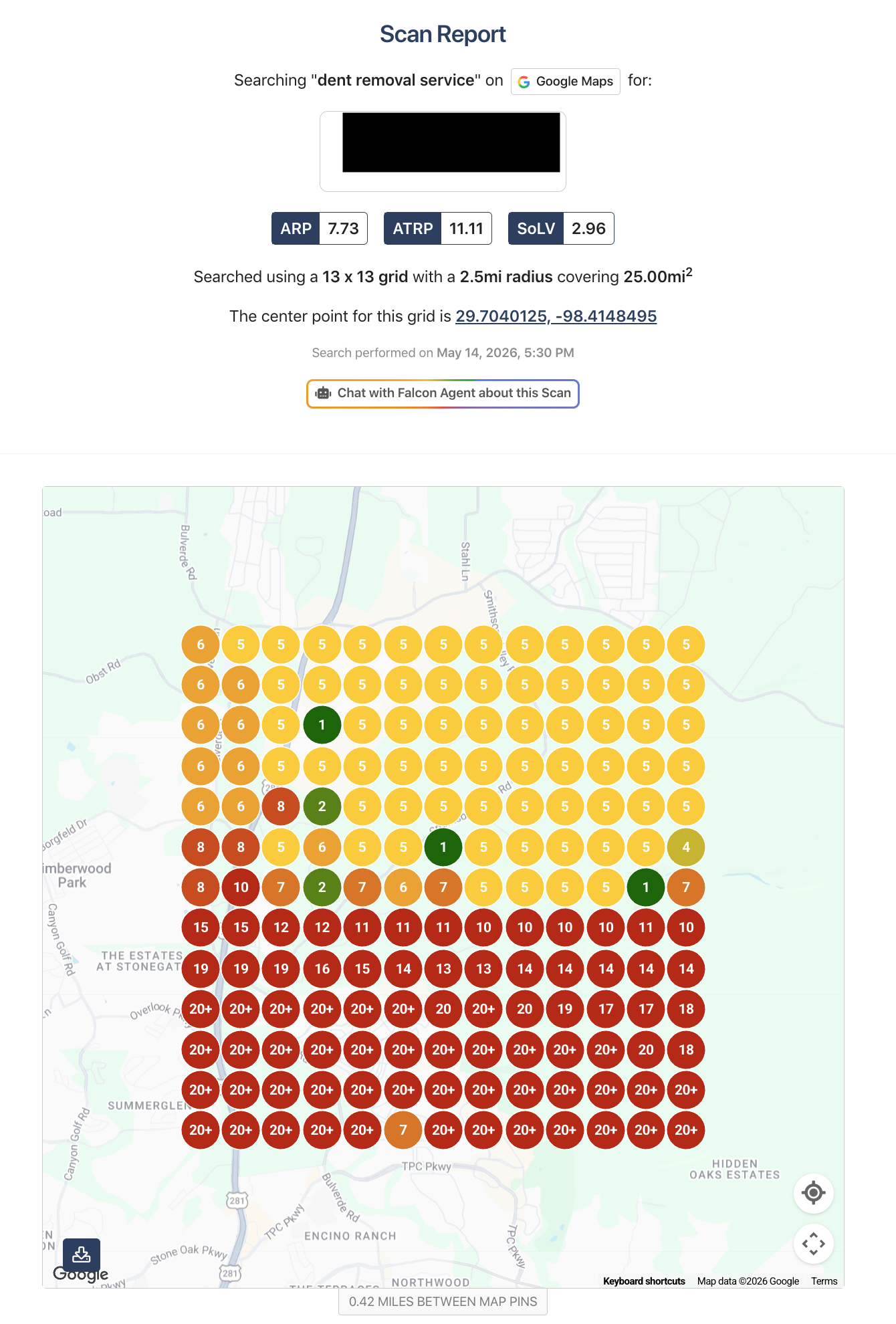
Dent Removal Service

  • Date: May 14, 2026, 5:30 PM
  • Range: 13 × 13 grid with a 2.5-mile radius
  • Coverage: 25.00 square miles
  • Metrics: ARP 7.73 · ATRP 11.11 · SoLV 2.96
Anonymized GHL Meets SEO local SEO search grid for Dent Removal Service from May 14 2026, using a 13 by 13 Google Maps grid across a 2.5-mile radius and 25-square-mile area, with many ranking positions outside the primary local Map Pack.
Map-focused preview
Click to Zoom
Later Scan

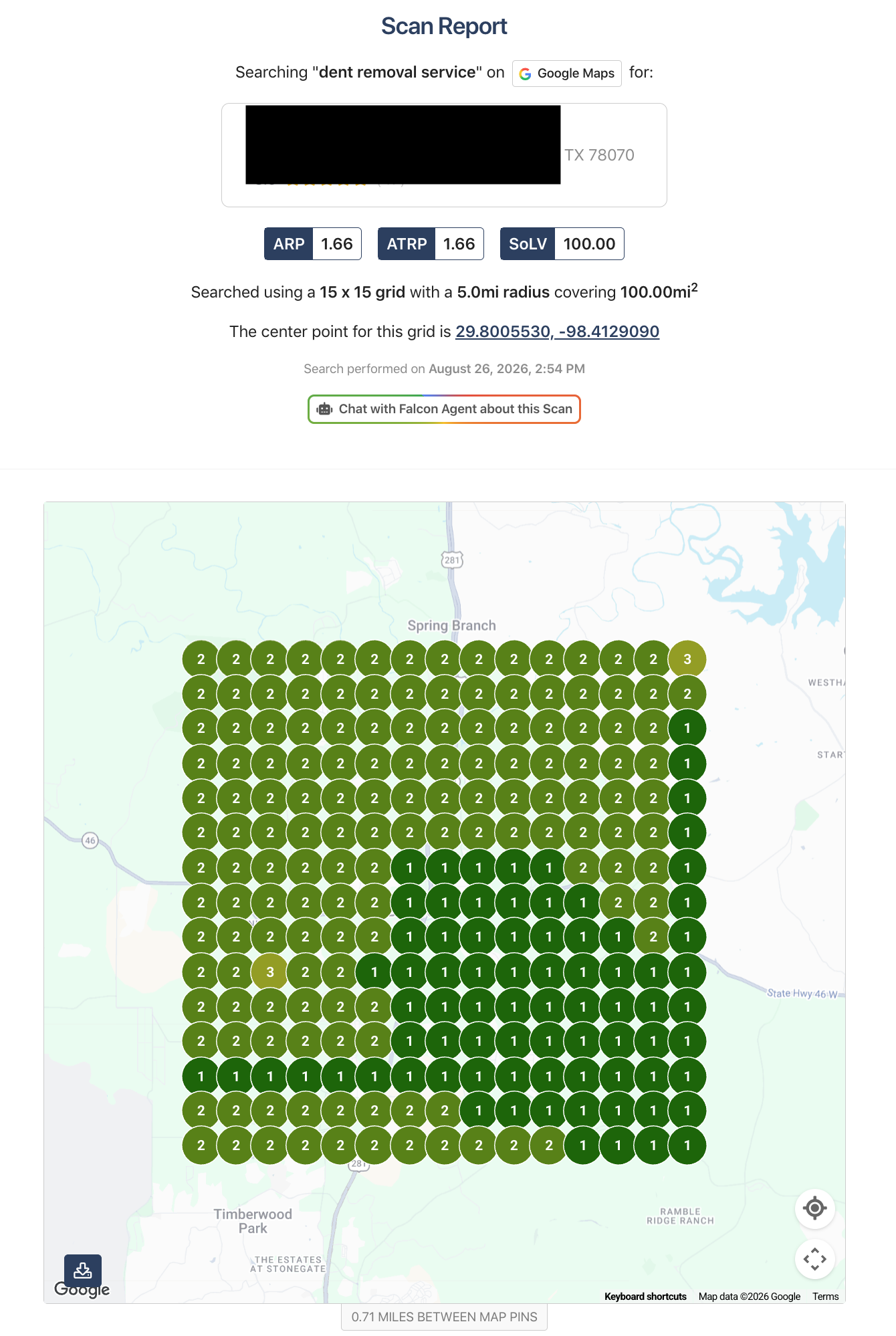
Dent Removal Service

  • Date: August 26, 2026, 2:54 PM
  • Range: 15 × 15 grid with a 5.0-mile radius
  • Coverage: 100.00 square miles
  • Metrics: ARP 1.66 · ATRP 1.66 · SoLV 100.00
Anonymized GHL Meets SEO local SEO search grid for Dent Removal Service from August 26 2026, using a 15 by 15 Google Maps grid across a 5-mile radius and 100-square-mile area, showing number one and number two rankings across nearly the entire scan.
Map-focused preview
Click to Zoom
What This Comparison Shows

The later report expands the search area from 25 square miles to 100 square miles. This creates a broader and more difficult test of how consistently the Google Business Profile appears across the surrounding market. The August grid shows a major concentration of positions 1 and 2 across that expanded area.

Section 02

Additional Keyword Searches

These additional searches were run on the same day and map size as the latest comparison scans to provide a broader view of local visibility across related service terms.

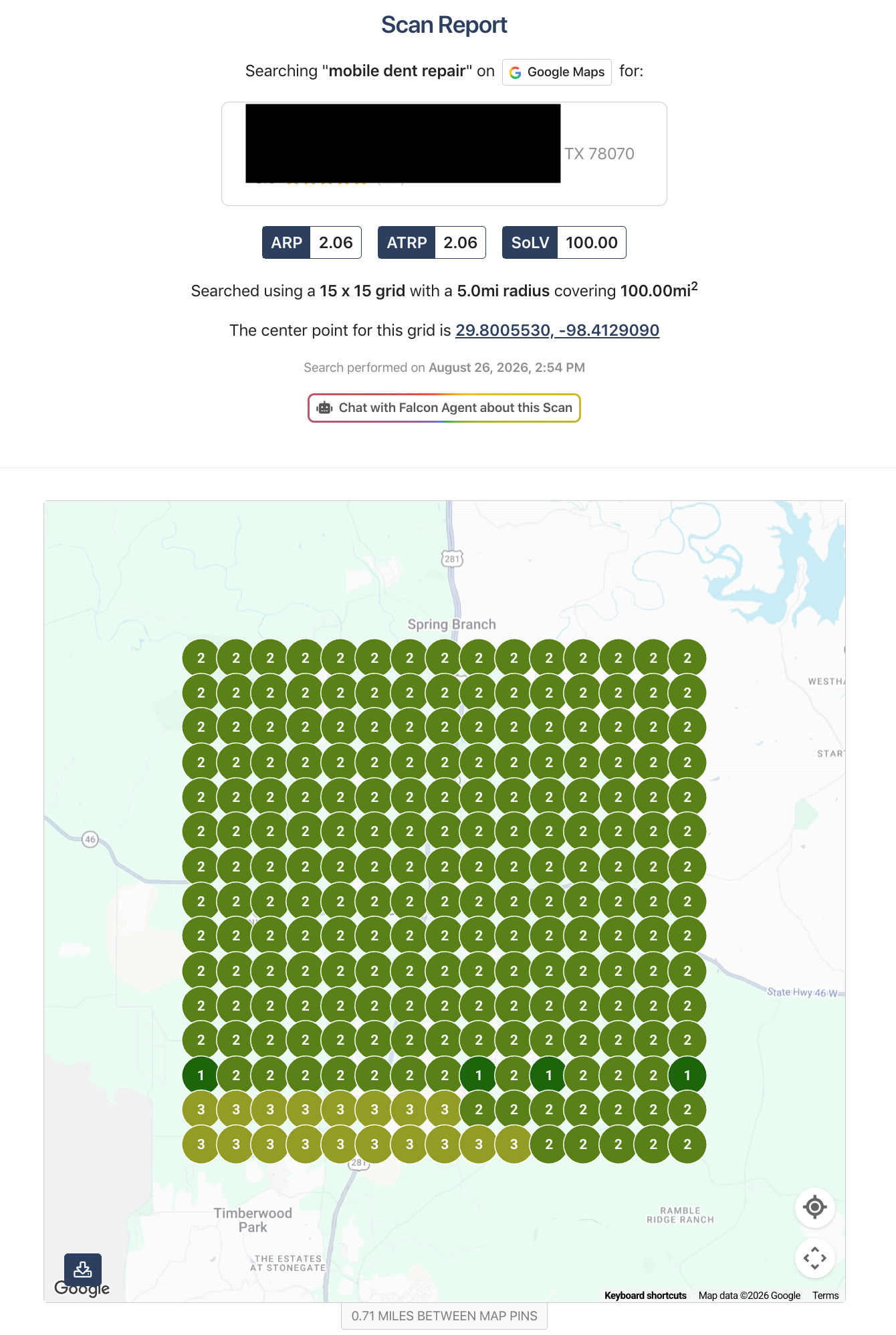
Mobile Dent Repair

An additional same-day keyword scan showing visibility for a closely related service search across the larger August search area.

Same-Day Additional Scan 15 × 15 Grid 100 Square Miles
Anonymized GHL Meets SEO local SEO search grid for Mobile Dent Repair from August 26 2026, using a 15 by 15 Google Maps grid across a 5-mile radius and 100-square-mile area, with every tested point ranking in the top three and most positions ranking number two.
Map-focused preview
Click to Zoom
ARP 2.06 ATRP 2.06 SoLV 100.00

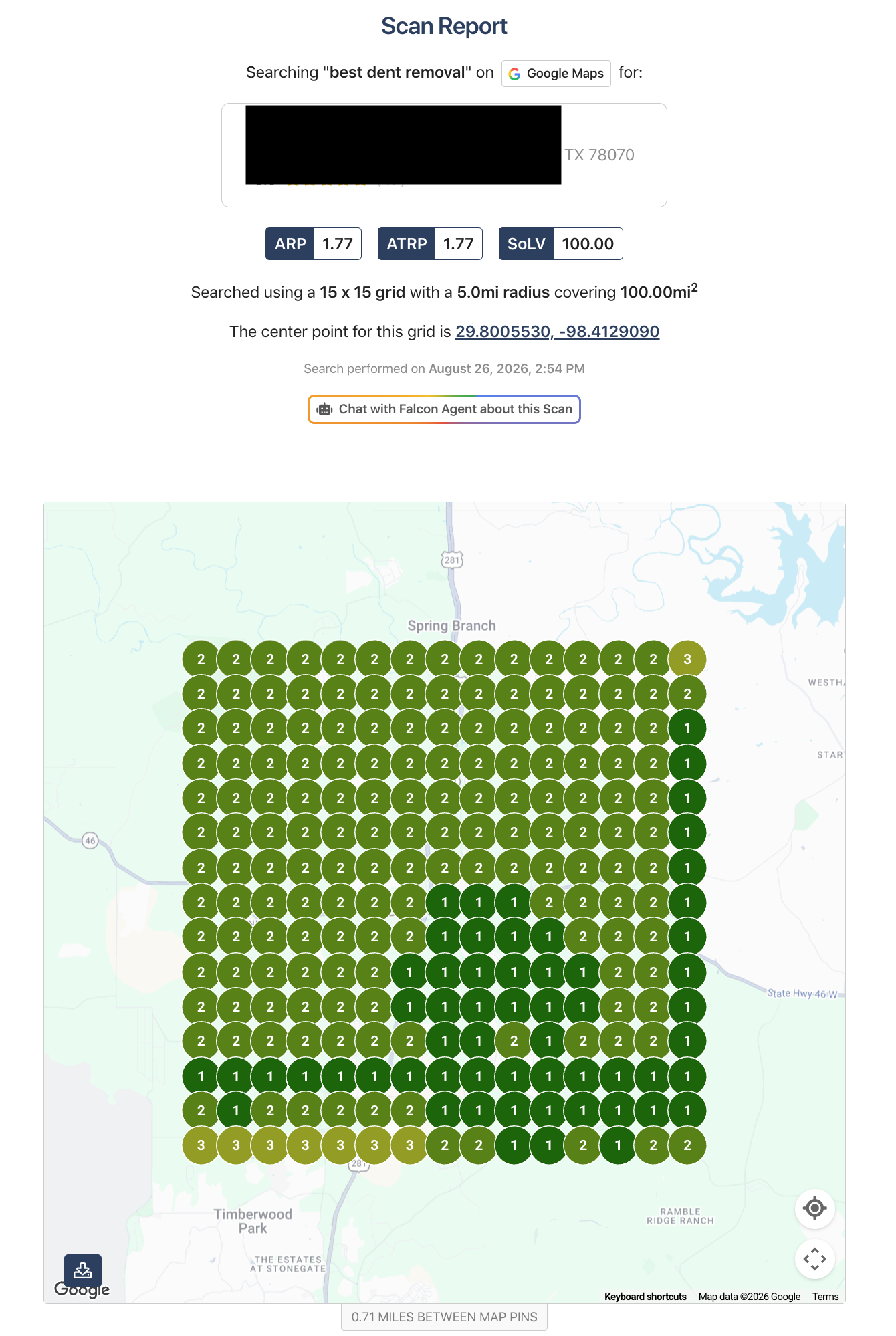
Best Dent Removal

A second same-day search variation used to measure local visibility across the same expanded geographic area.

Same-Day Additional Scan 15 × 15 Grid 100 Square Miles
Anonymized GHL Meets SEO local SEO search grid for Best Dent Removal from August 26 2026, using a 15 by 15 Google Maps grid across a 5-mile radius and 100-square-mile area, with every tested location ranking inside the top three local results.
Map-focused preview
Click to Zoom
ARP 1.77 ATRP 1.77 SoLV 100.00
Section 03

How These Search Grids Work

Every numbered dot represents a Google search performed from that exact location on the map for the listed keyword.

What the Numbers Mean

Search grids measure where an anonymous business appears in Google's local map results from many different locations instead of checking rankings from only one address.

1–3
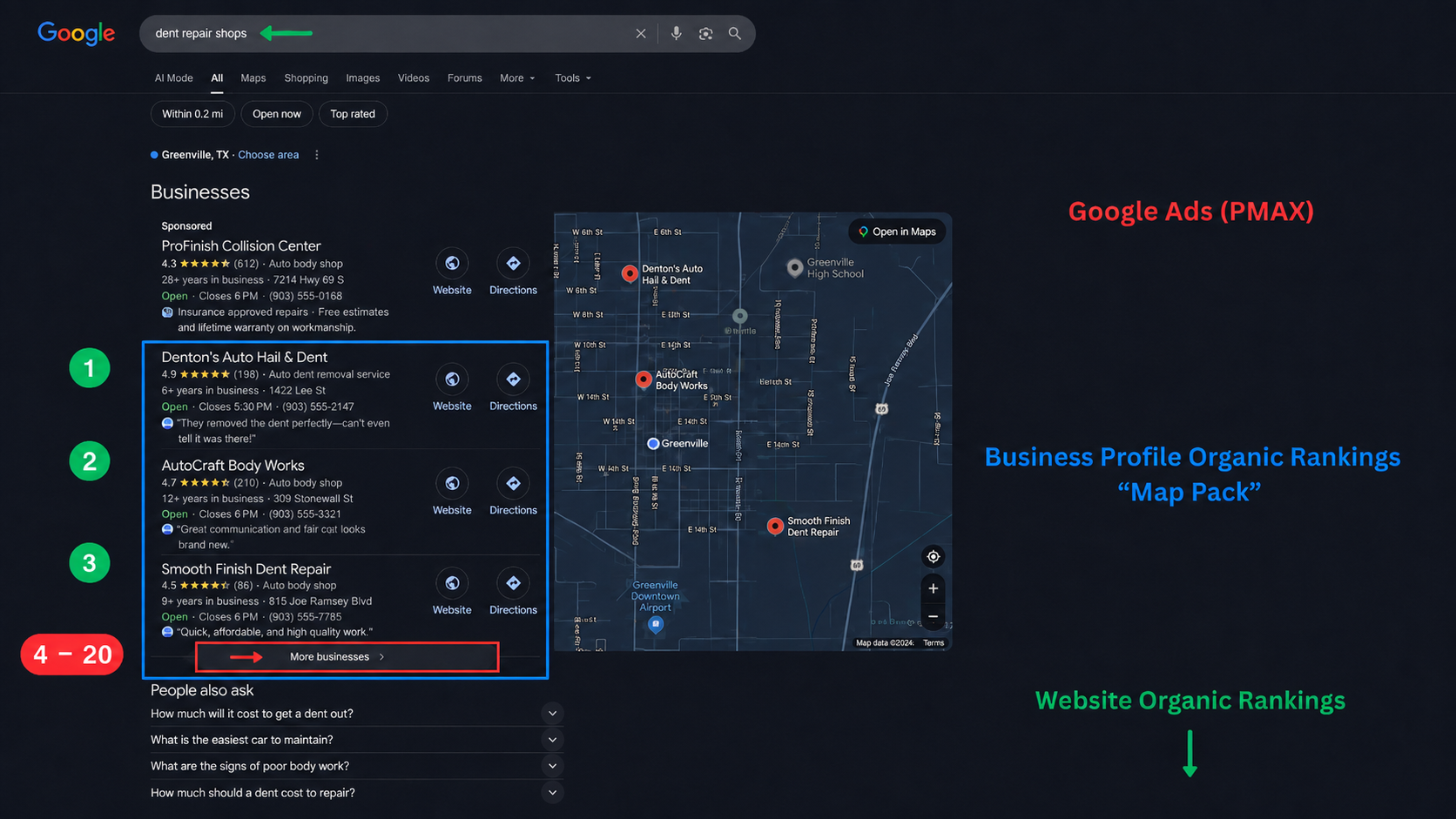
Positions 1–3 These are the three businesses normally shown directly in Google's primary local Map Pack. Searchers can see and interact with these listings without opening the larger list of businesses.
4+
Positions 4–20 The profile is still ranking, but the searcher generally must click to view more businesses before reaching lower organic map listings. Paid placements may also appear above them.
Why the grid size matters

A smaller grid measures rankings closer to the business. A larger grid tests how far the profile's visibility extends across the surrounding market. Increasing both the radius and total coverage creates a broader local ranking test.

Why rankings change from one dot to another

Google local rankings can change block by block because proximity, relevance, prominence, reviews, website strength, business information, and nearby competitors can all influence which businesses Google displays.

GHL Meets SEO Google Map Pack example explaining paid Google Ads placement, organic Google Business Profile positions one through three, lower map results, and website organic rankings without identifying the case-study client.
Map Pack example: rankings 1–3 appear directly in the primary local results. Lower positions generally require an additional click. Paid ads and website organic rankings are separate result types.
Section 04

Frequently Asked Questions

What does each number on the search grid mean?

The number represents the Google Business Profile ranking position for that keyword when the search is performed from that exact location on the map. Lower numbers are better.

Why are positions 1–3 important?

Positions 1–3 are normally visible directly inside Google's primary local Map Pack. The searcher can see and interact with those businesses without clicking to view additional listings.

What happens when the business ranks from 4–20?

The profile is still ranking, but a searcher generally has to open more local results to reach those additional listings. Google may also display paid advertisements before those organic results.

Why can rankings change across different parts of the map?

Google local rankings are location-sensitive. Proximity to the searcher, relevance, reviews, prominence, website strength, business information, and nearby competition can all affect the ranking at each individual search point.

Why are the May and August reports not perfectly identical comparisons?

The May reports use a 13 × 13 grid with a 2.5-mile radius covering 25 square miles. The August reports use a larger 15 × 15 grid with a 5-mile radius covering 100 square miles. The later reports therefore test visibility across a significantly larger area.

Anonymized client-report example. Business-identifying information has been removed for this public GHL Meets SEO case study. The screenshots and ranking data shown above are retained to demonstrate the reporting format and underlying local-search results.
Agency Breakdown · What Changed

The Important Part Is Not Just More Green Dots

The strongest takeaway is that the later scans did not simply look better close to the business. They covered a four-times-larger geographic area and still showed dramatically stronger local visibility across the two comparison keywords.

The May scans covered 25 square miles with a 2.5-mile radius. The August scans expanded to 100 square miles with a 5-mile radius and a larger 15 × 15 grid. That matters because broader local search grids normally expose more areas where proximity and competing businesses can weaken visibility. In this case, the later scans were broader while the ranking distribution became substantially stronger.

Dent Repair ARP 7.12 → 1.60 About a 77.5% reduction in average ranked position.
Dent Repair ATRP 9.25 → 1.60 About an 82.7% reduction across the total scan area.
Dent Repair SoLV 1.78 → 100 Top-three visibility across the entire later scan.
Keyword May Scan August Scan What Changed
Dent Repair ARP 7.12 · ATRP 9.25 · SoLV 1.78 ARP 1.60 · ATRP 1.60 · SoLV 100.00 Much stronger average positions while coverage expanded from 25 to 100 sq. mi.
Dent Removal Service ARP 7.73 · ATRP 11.11 · SoLV 2.96 ARP 1.66 · ATRP 1.66 · SoLV 100.00 A similar improvement pattern across the second high-intent service keyword.
Mobile Dent Repair ARP 2.06 · ATRP 2.06 · SoLV 100.00 Top-three visibility at every tested point in the 100-square-mile August grid.
Best Dent Removal ARP 1.77 · ATRP 1.77 · SoLV 100.00 Another related query with complete top-three coverage across the later scan.
Do not overstate the comparison: the May and August scans use different grid sizes, radiuses, and center points, so they are not controlled before-and-after experiments. The useful observation is that the later, broader scans show substantially stronger visibility despite testing a larger surrounding market. Local search results also change over time for many reasons, so this report should be read as evidence of the observed outcome—not proof that one specific tactic alone caused it.
Local SEO Reporting

How to Read ARP, ATRP, and Share of Local Voice

A search grid becomes much easier to explain when an agency reduces the report to three ideas: where the business ranks when it appears, how it performs across the entire grid, and how often it reaches the top three.

ARP

Average Ranked Position

ARP is the average ranking position across scan points where the business is found within the tracked ranking range. Lower is better. A value near 1–2 means the business is usually appearing very high when it is found.

ATRP

Average Total Ranked Position

ATRP accounts for all scanned points, including locations where the business is not found in the tracked top results. When ARP and ATRP are both low and close together, visibility is generally strong and consistent across the tested area.

SoLV

Share of Local Voice

Share of Local Voice measures how often the business ranks in positions 1–3 across the grid. A SoLV score of 100 means every tested point qualified for top-three Map Pack visibility for that scan.

This is why the August results are easy to communicate to a client without turning the report into an analytics lecture. Instead of saying only that “rankings improved,” an agency can explain that the profile moved from inconsistent visibility across a smaller area to top-three visibility throughout a substantially larger scan area. The picture and the metrics tell the same story.

HighLevel SEO + Local SEO

What This Says About Local SEO With HighLevel—and What It Does Not

This is a Google Business Profile ranking report, not a Google Search Console website-ranking report. That distinction matters when agencies talk about HighLevel SEO results and the role a HighLevel website can play in a local-search strategy.

What a HighLevel Website Can Support

  • Dedicated service pages that reinforce the services a business actually provides.
  • Service-area and city pages that expand locally relevant website coverage.
  • Consistent business information, internal linking, metadata, schema, and Google Maps integration.
  • Ongoing articles and supporting content that build topical depth around the business and its market.
  • Clear conversion paths so increased search visibility has somewhere useful to send prospective customers.

What the Website Does Not Control by Itself

  • Google Business Profile proximity relative to each searcher.
  • Competitor locations, reviews, prominence, categories, and local-market strength.
  • Google algorithm updates or the exact Map Pack shown for every search.
  • The business's operational history, reputation, citations, backlinks, or every off-site signal.
  • A guaranteed ranking, lead count, or specific revenue outcome.

The useful agency takeaway is that a HighLevel website does not need to be treated as a separate “website project” that sits outside local SEO. When it is built with service relevance, local structure, internal linking, technical SEO, schema, conversion tracking, and continued content expansion in mind, it can become part of the broader ecosystem supporting the business's organic visibility.

That is the direction behind GHL Meets SEO V6 and the GHL Zone Agents: use HighLevel as the native website platform, then standardize the research, content, image, page-building, internal-linking, publishing, and reporting processes around it. The goal is not to claim that HighLevel itself creates rankings. The goal is to remove the old assumption that agencies must leave HighLevel to build a serious SEO-focused website and content system.

Agency Sales + Retention

Why Simple Visual Reporting Is Valuable Even When the SEO Work Is Complex

Agencies often do a lot of work that a client never sees. Search grids help translate that work into something a business owner can understand in seconds: where am I showing up, how far does that visibility reach, and is the picture getting stronger?

Make Client Value Easier to See

A client does not need to understand every technical SEO task to understand that a map dominated by positions 1 and 2 is stronger than a map filled with lower positions. A short explanation of grid size, coverage, and top-three visibility makes the report useful without making it overwhelming.

Use the Same Proof in New Sales

Anonymized reports can become credible examples for prospects. Instead of promising that SEO “works,” an agency can show the type of tracking it performs, explain how local visibility is measured, and demonstrate real reporting from completed client work without exposing the client's identity.

Separate Activity From Outcomes

“We published six pages” describes activity. “The profile now ranks inside the top three across this entire grid” describes an observed outcome. Strong client reporting should include both, while being careful not to attribute every ranking change to one activity without evidence.

Give the Next Conversation a Starting Point

A grid can reveal where visibility is already strong and where it becomes weaker. That gives the agency a practical next discussion around content, service areas, reviews, citations, website relevance, competition, and other local-search opportunities instead of sending a report with no interpretation.

The reporting format itself can become part of the agency's product. If every local SEO client receives a consistent explanation of the same core metrics, similar search-grid screenshots, and a short interpretation of what changed, reporting becomes easier to fulfill and easier for account managers or salespeople to reuse. That is valuable whether the agency uses GHL Meets SEO or builds its own process.

Repeatable Agency Workflow

A Better Way to Standardize Local SEO Reporting

The exact tools can change. The reporting discipline should not. A repeatable workflow gives agencies cleaner comparisons, faster client communication, and a growing library of real proof.

1
Choose Core Keywords Track the service terms that actually matter to the business, not a random list of easy keywords.
2
Keep Scan Settings Consistent Use the same center, grid size, radius, and keyword when you want the cleanest trend comparison.
3
Add the Context Call out when the coverage changes, when a test is broader, or when a comparison is not perfectly controlled.
4
Pair Rankings With Business Data Where possible, combine local visibility with Search Console, Analytics, GBP interactions, calls, forms, and leads.
5
Archive the Proof Keep the screenshots and summaries so client results can support retention, case studies, and future sales conversations.

GHL Meets SEO is moving this same idea toward a more automated agency workflow: repeatable HighLevel page templates, Snapshot structure, GHL Zone Agents, standardized SEO production, and increasingly standardized result reporting. The more consistent the inputs and reporting format become, the easier it is to scale fulfillment without turning every client into a completely different project.

HighLevel Local SEO FAQ

Questions Agencies Ask About HighLevel SEO and Local Ranking Reports

Can a website built in HighLevel rank in Google?

Yes. A HighLevel website can be crawled and indexed like other websites when it is published correctly and built with useful content, sound technical structure, internal linking, metadata, schema, mobile usability, and other SEO fundamentals. The platform alone does not guarantee rankings; execution and the competitiveness of the market still matter.

Does a HighLevel website automatically improve Google Business Profile rankings?

No. Google Business Profile rankings depend on multiple local-search factors, including proximity, relevance, prominence, reviews, competition, business information, website signals, and other factors. A well-built HighLevel website can support the overall local SEO ecosystem, but it does not control the Map Pack by itself.

What does a SoLV score of 100 mean in a local search grid?

Share of Local Voice measures how often the business ranks in positions 1–3 across the scanned locations. A score of 100 means the business ranked in the top three at every tested point for that keyword and scan configuration.

Is a larger Google Maps search grid harder than a smaller grid?

A larger geographic area generally tests visibility farther away from the business, where proximity and different competitors may have more influence. That makes broader scans useful for understanding market reach, although changing scan settings also means the results are not a perfectly controlled comparison with an earlier smaller grid.

How often should an agency run local ranking grids?

The useful cadence depends on the campaign, market, budget, and reporting schedule. The most important practice is consistency: when measuring a trend, keep the tracked keyword and scan settings as consistent as possible so changes are easier to interpret.

Do local search-grid rankings prove that SEO generated more leads?

No. Search grids measure visibility, not lead attribution. Agencies should pair ranking data with Google Search Console, Analytics, Google Business Profile interactions, tracked calls, forms, booked appointments, and CRM conversion data whenever possible to connect visibility with business outcomes.

Why are anonymized SEO case studies useful for agencies?

They allow agencies to demonstrate real reporting methods and real performance data without exposing a client's identity. A prospect can still understand the industry, the starting point, the measurement method, and the type of result that was observed while the client relationship remains private.

How does GHL Meets SEO fit into this reporting process?

GHL Meets SEO focuses on building and expanding SEO-oriented websites directly in HighLevel using standardized page structures, content workflows, internal linking, technical optimization, and GHL Zone Agents. Local search-grid reporting is one way agencies can measure and communicate part of the broader local SEO outcome. Rankings and business results are never guaranteed.

See More Real Reports—or Build the System Into Your Agency

Browse additional anonymized GHL Meets SEO case studies, join the email list for new reports and Agent updates, or see how our White Label Partner model helps HighLevel agencies add website and SEO fulfillment without building another production department.