GHL Meets SEO — Header
[email protected] (828) 358-2389
Support Portal
TL;DR

This Houston optometry account tells two different organic-search stories at the same time. Across four matched 13 × 13 Google Business Profile grids, local visibility remained comparatively steady with incremental improvement inside a tight, competitive two-mile market. Meanwhile, after roughly two years of consistent SEO content production, the website continued to accelerate: the latest six-month Search Console period produced more than twice the organic traffic of the prior six months while average search position also improved.

Local SEO + Website Growth Case Study

Google Business Profile + Website Report: Optometrist in Houston, TX

This case study combines four matched Google Business Profile search-grid comparisons with long-term Google Search Console reporting for a Houston-area optometry practice. The local grids show why Map Pack distance can remain stubborn in a dense healthcare market, while the website data shows something very different: organic search growth can continue compounding long after the first year of consistent SEO production.

Industry: Optometry Market: Houston, Texas Report Date: August 2026 Focus: GBP + Website Search Grid Coverage: 16 sq. mi.
GHL Meets SEO Client Report · Google Business Profile + Website Search
All Case Studies
Prepared by GHL Meets SEO

Local Business + Website Performance Report

A consolidated view of Google Maps visibility and organic website search growth for an optometry practice competing in the Houston market.

Industry: Optometry Market: Houston, Texas Local: Google Maps / GBP Website: Google Search Console Data Through: Aug. 28, 2026
Matched Grid Terms4
Points per Grid169
Latest 6-Mo. Traffic>2×
SEO Content History2 Years
Section 01 · Google Maps Visibility

Four Matched Local Search Comparisons

Each pair compares the same search term on May 5 and August 28, 2026 using the same 13 × 13 grid, two-mile radius, and Houston-centered 16-square-mile footprint. The smaller radius is intentional for a neighborhood-sensitive healthcare category where proximity and nearby alternatives can heavily influence the Map Pack.

Standard scan footprint: Each grid contains 169 search points across a 2-mile radius / 16-square-mile area. These are four true before-and-after keyword comparisons: Eye Doctor, Eye Exam, Vision Center, and Optometrist.
Search Term: Eye Doctor

A Core Category Search Held Its Ground in a Dense Medical Market

The May and August scans show the same Houston-area search footprint for a high-intent category phrase. The profile remained competitive close to the practice while the outer points continued to reflect the reality of a city with many nearby eye-care options.

May 5 → Aug. 28, 2026
Grid 13 × 13 169 tested search points
Radius 2 Miles 16-square-mile local footprint
Direction Stable / Improving Read the screenshots for point-level movement
May 5, 2026
13 × 13 Grid2-Mile Radius16 sq. mi.
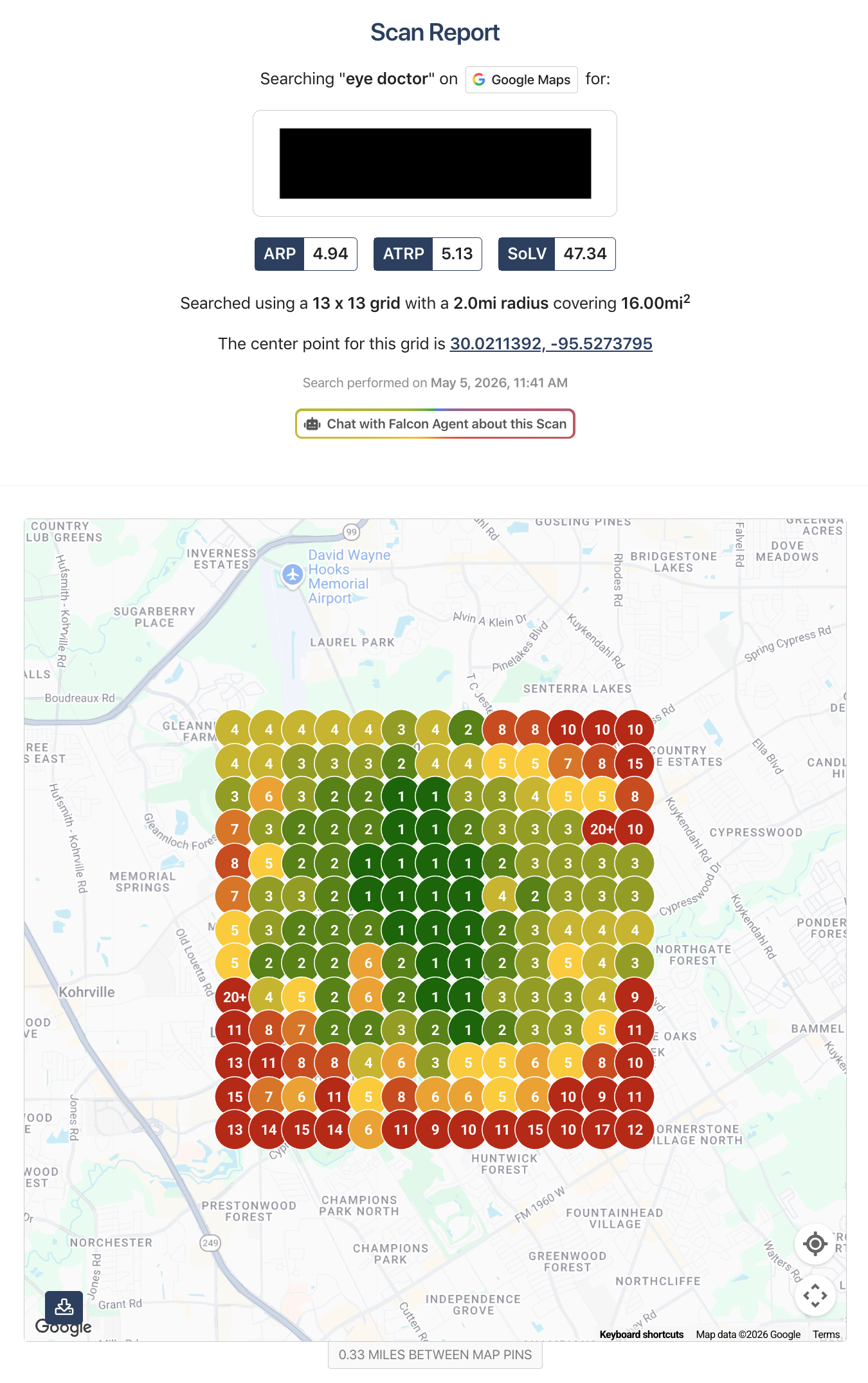
Google Maps search grid for Eye Doctor in Houston on May 5 2026 using a 13 by 13 grid across a 2-mile radius and 16-square-mile area.
Search Term: Eye Doctor
Click to Zoom
August 28, 2026
13 × 13 Grid2-Mile Radius16 sq. mi.
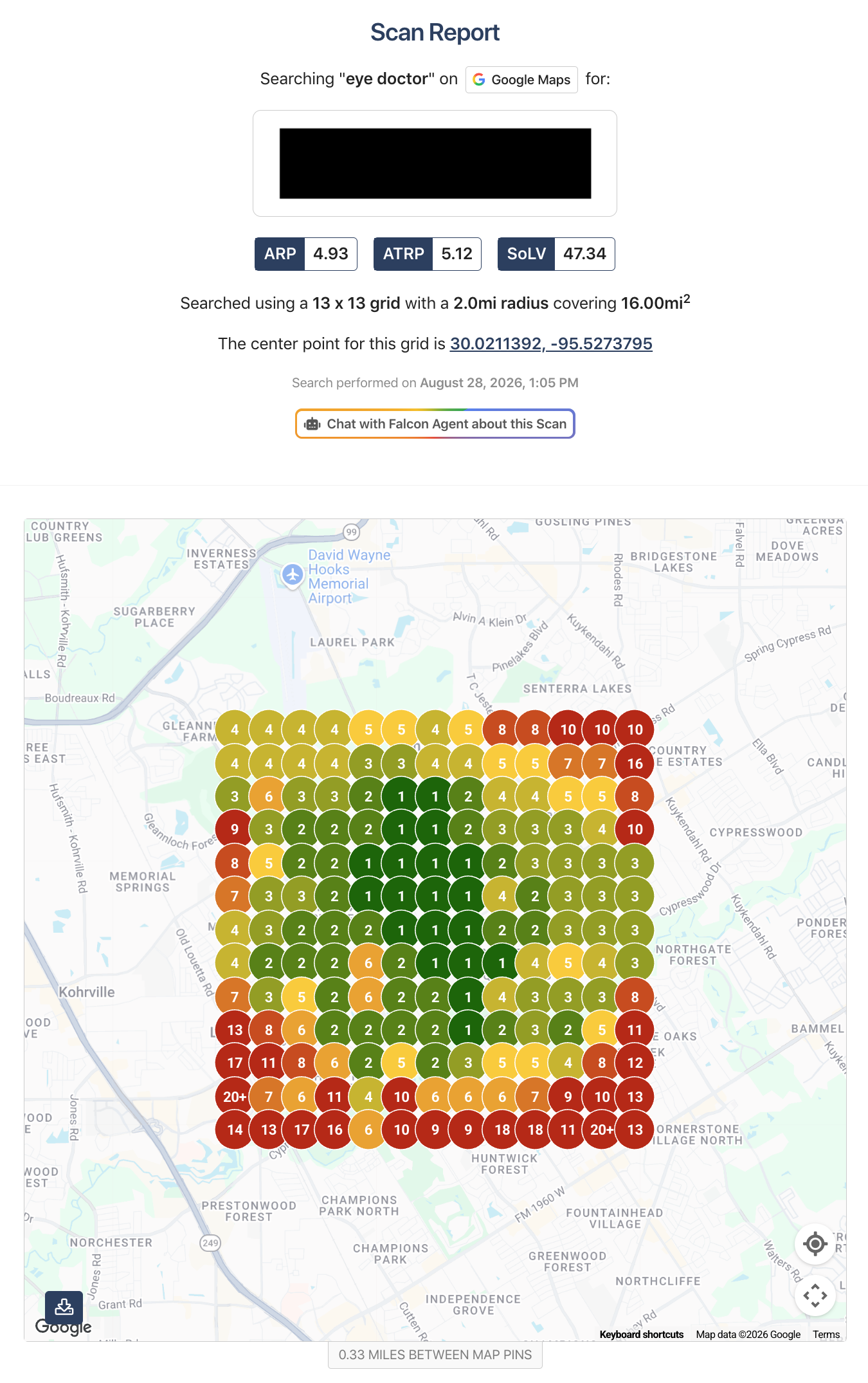
Google Maps search grid for Eye Doctor in Houston on August 28 2026 using a 13 by 13 grid across a 2-mile radius and 16-square-mile area.
Search Term: Eye Doctor
Click to Zoom
What to look for: Read this pair as a stability-and-reach comparison: the goal is not to force every point to rank first, but to see whether the useful top-three footprint holds or expands as the local result set changes.
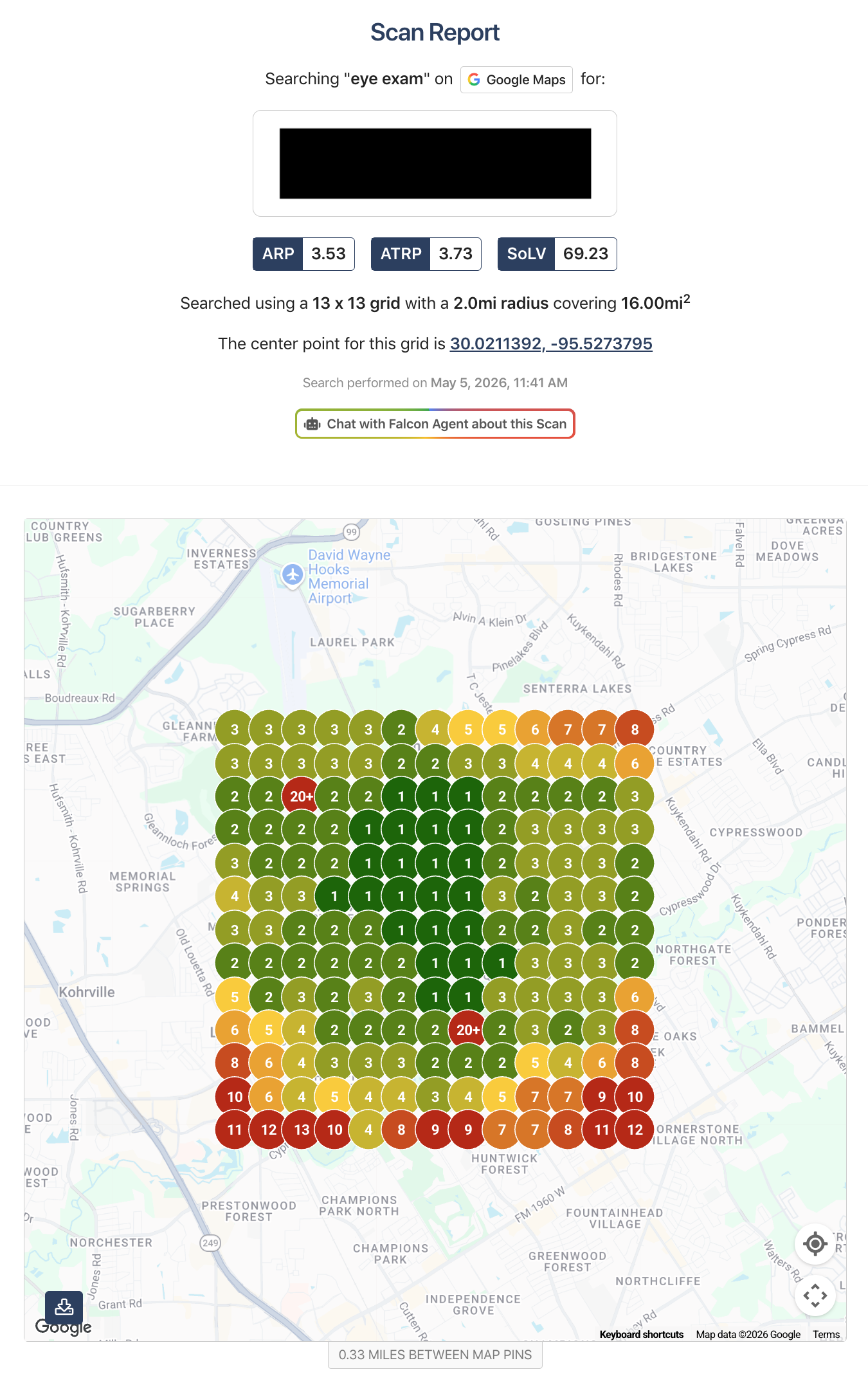
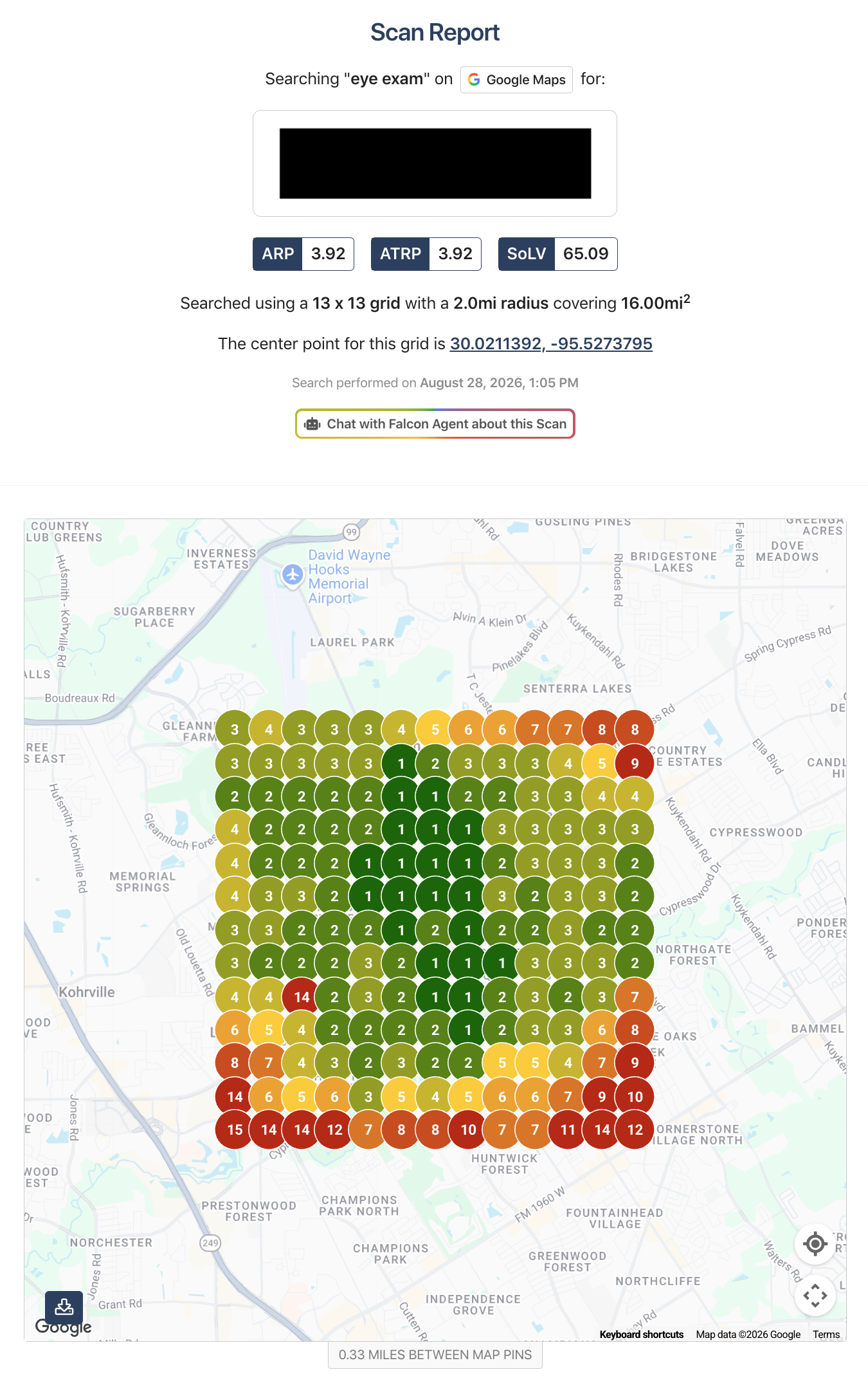
Search Term: Eye Exam

Service Intent Behaved Differently Than the Provider Category

“Eye Exam” represents a service need rather than a provider label. Comparing the same 13 × 13 footprint over time helps separate changes in service-specific visibility from the broader “eye doctor” category.

May 5 → Aug. 28, 2026
Grid 13 × 13 169 tested search points
Radius 2 Miles 16-square-mile local footprint
Direction Stable / Improving Read the screenshots for point-level movement
May 5, 2026
13 × 13 Grid2-Mile Radius16 sq. mi.
Google Maps search grid for Eye Exam in Houston on May 5 2026 using a 13 by 13 grid across a 2-mile radius and 16-square-mile area.
Search Term: Eye Exam
Click to Zoom
August 28, 2026
13 × 13 Grid2-Mile Radius16 sq. mi.
Google Maps search grid for Eye Exam in Houston on August 28 2026 using a 13 by 13 grid across a 2-mile radius and 16-square-mile area.
Search Term: Eye Exam
Click to Zoom
What to look for: A patient searching for an exam may evaluate convenience, insurance, availability, and nearby alternatives differently than someone searching for a provider category. That makes the keyword its own local market.
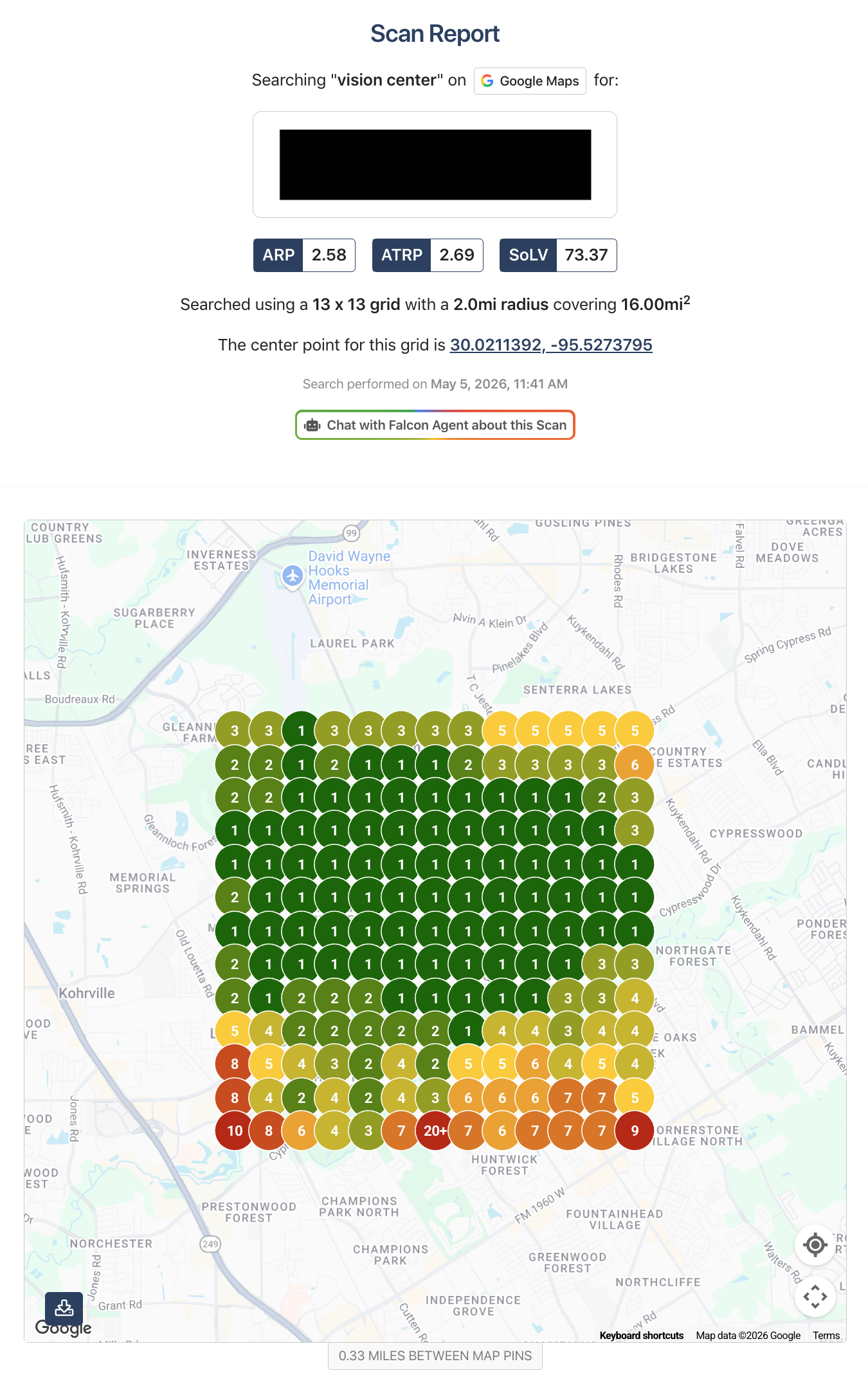
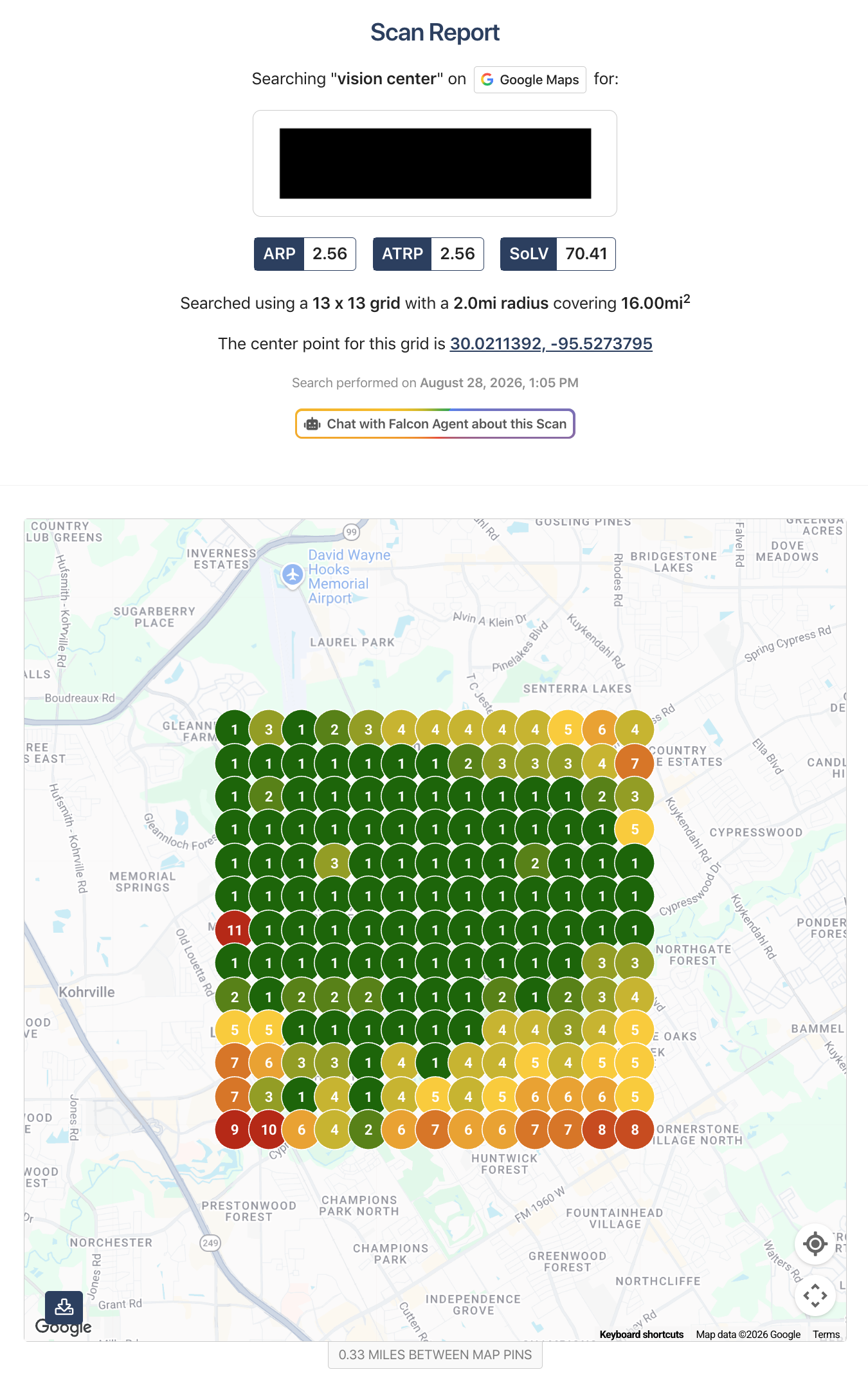
Search Term: Vision Center

Retail-Style Search Language Introduced a Different Competitive Set

“Vision Center” can surface a mix of optometry practices, optical retailers, and multi-service eye-care locations. That broader interpretation can make the Map Pack more competitive even when the practice remains strong for more clinical terms.

May 5 → Aug. 28, 2026
Grid 13 × 13 169 tested search points
Radius 2 Miles 16-square-mile local footprint
Direction Stable / Improving Read the screenshots for point-level movement
May 5, 2026
13 × 13 Grid2-Mile Radius16 sq. mi.
Google Maps search grid for Vision Center in Houston on May 5 2026 using a 13 by 13 grid across a 2-mile radius and 16-square-mile area.
Search Term: Vision Center
Click to Zoom
August 28, 2026
13 × 13 Grid2-Mile Radius16 sq. mi.
Google Maps search grid for Vision Center in Houston on August 28 2026 using a 13 by 13 grid across a 2-mile radius and 16-square-mile area.
Search Term: Vision Center
Click to Zoom
What to look for: This is why local SEO reporting should preserve the exact query. Similar-sounding eye-care phrases can trigger meaningfully different competitors and ranking patterns.
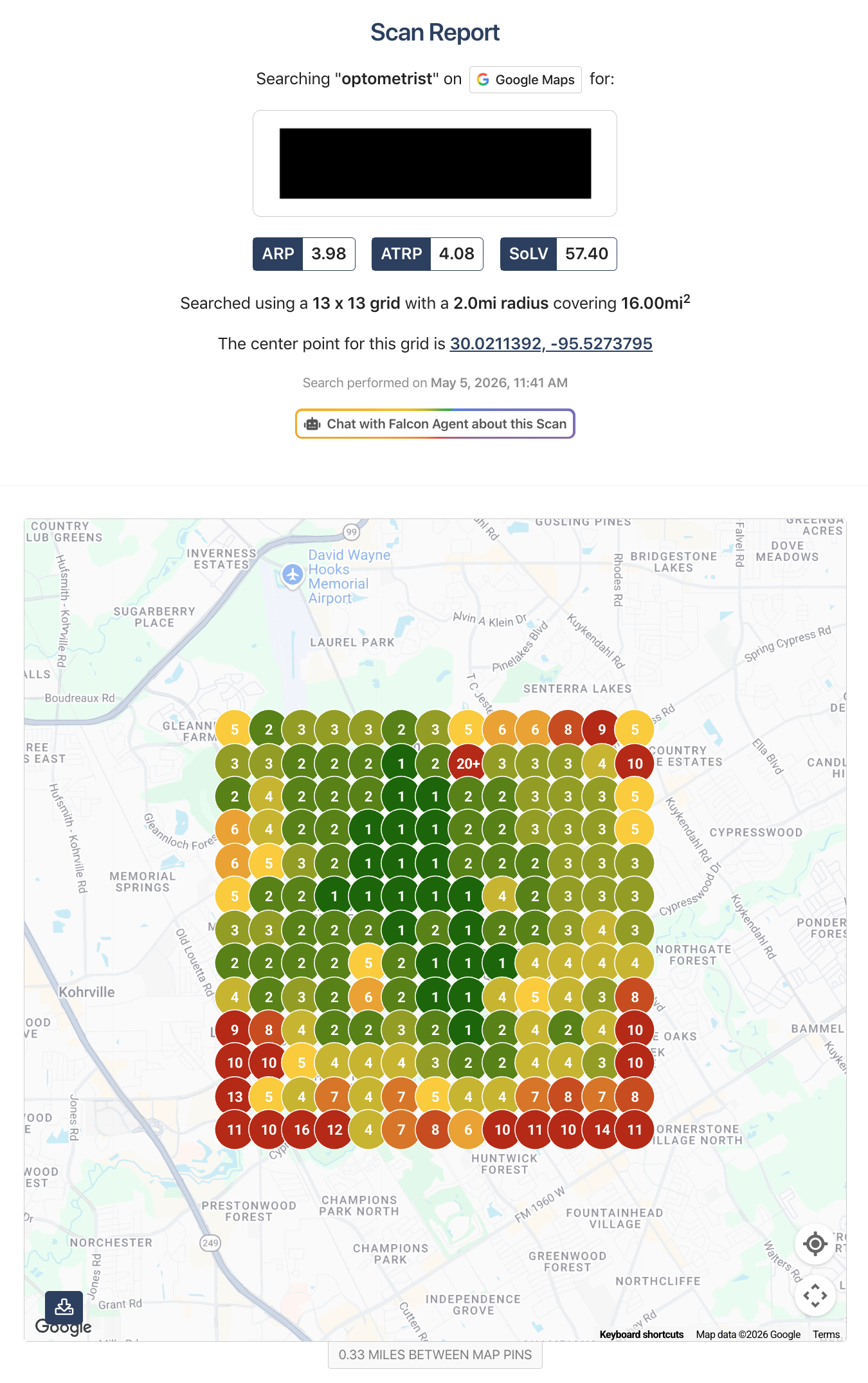
Search Term: Optometrist

The Professional-Service Term Shows Why Proximity Still Matters

“Optometrist” is the clearest professional category term in this report. The comparison reinforces that even a long-running SEO account can encounter a practical local radius where nearby alternatives make it harder to expand Map Pack coverage quickly.

May 5 → Aug. 28, 2026
Grid 13 × 13 169 tested search points
Radius 2 Miles 16-square-mile local footprint
Direction Stable / Improving Read the screenshots for point-level movement
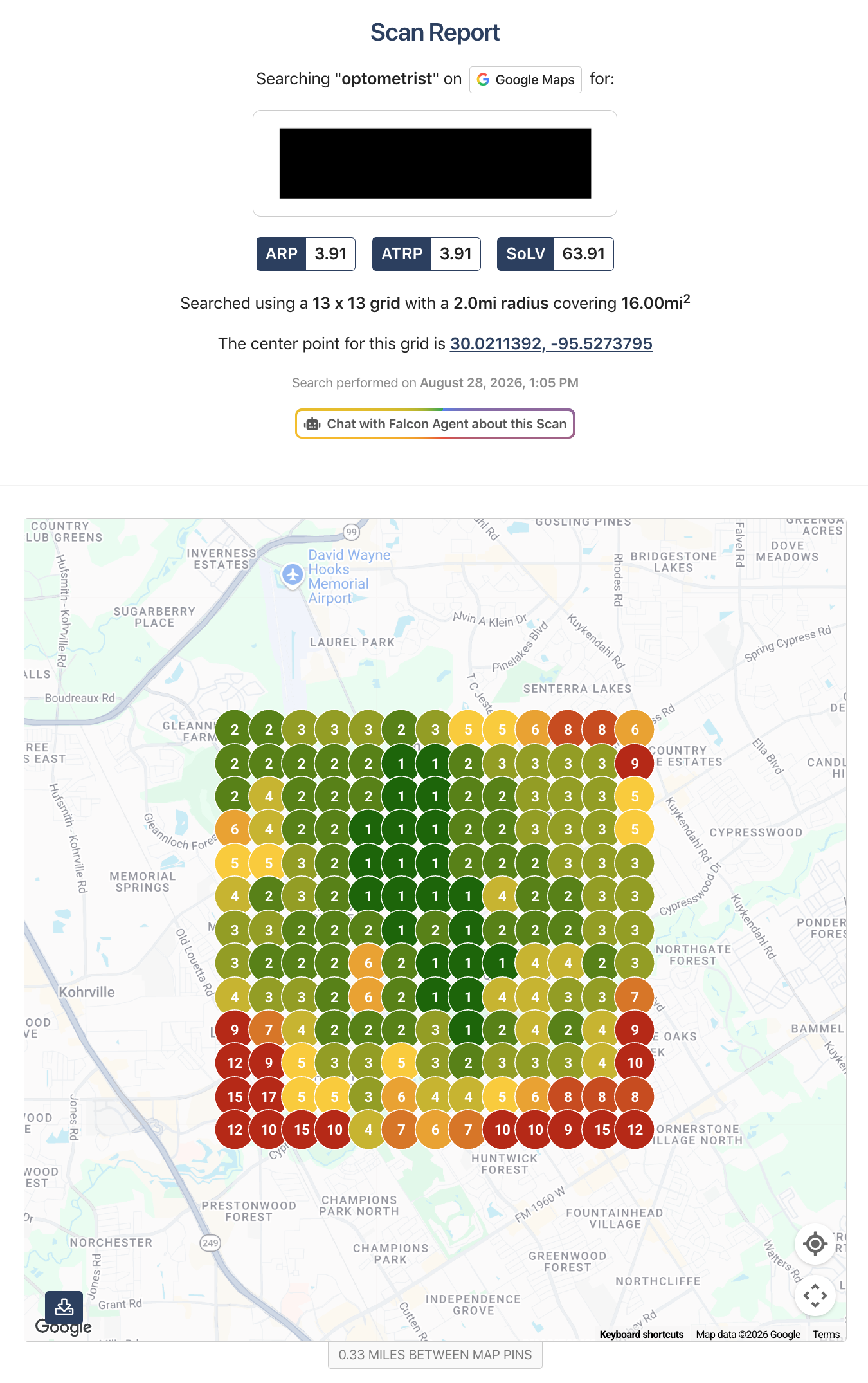
May 5, 2026
13 × 13 Grid2-Mile Radius16 sq. mi.
Google Maps search grid for Optometrist in Houston on May 5 2026 using a 13 by 13 grid across a 2-mile radius and 16-square-mile area.
Search Term: Optometrist
Click to Zoom
August 28, 2026
13 × 13 Grid2-Mile Radius16 sq. mi.
Google Maps search grid for Optometrist in Houston on August 28 2026 using a 13 by 13 grid across a 2-mile radius and 16-square-mile area.
Search Term: Optometrist
Click to Zoom
What to look for: For a neighborhood-driven healthcare service, steady top-three presence inside the most valuable radius can be more commercially meaningful than chasing a visually perfect grid far beyond normal patient travel behavior.
Section 02 · Reading the Map Pack

What the Grid Positions Represent

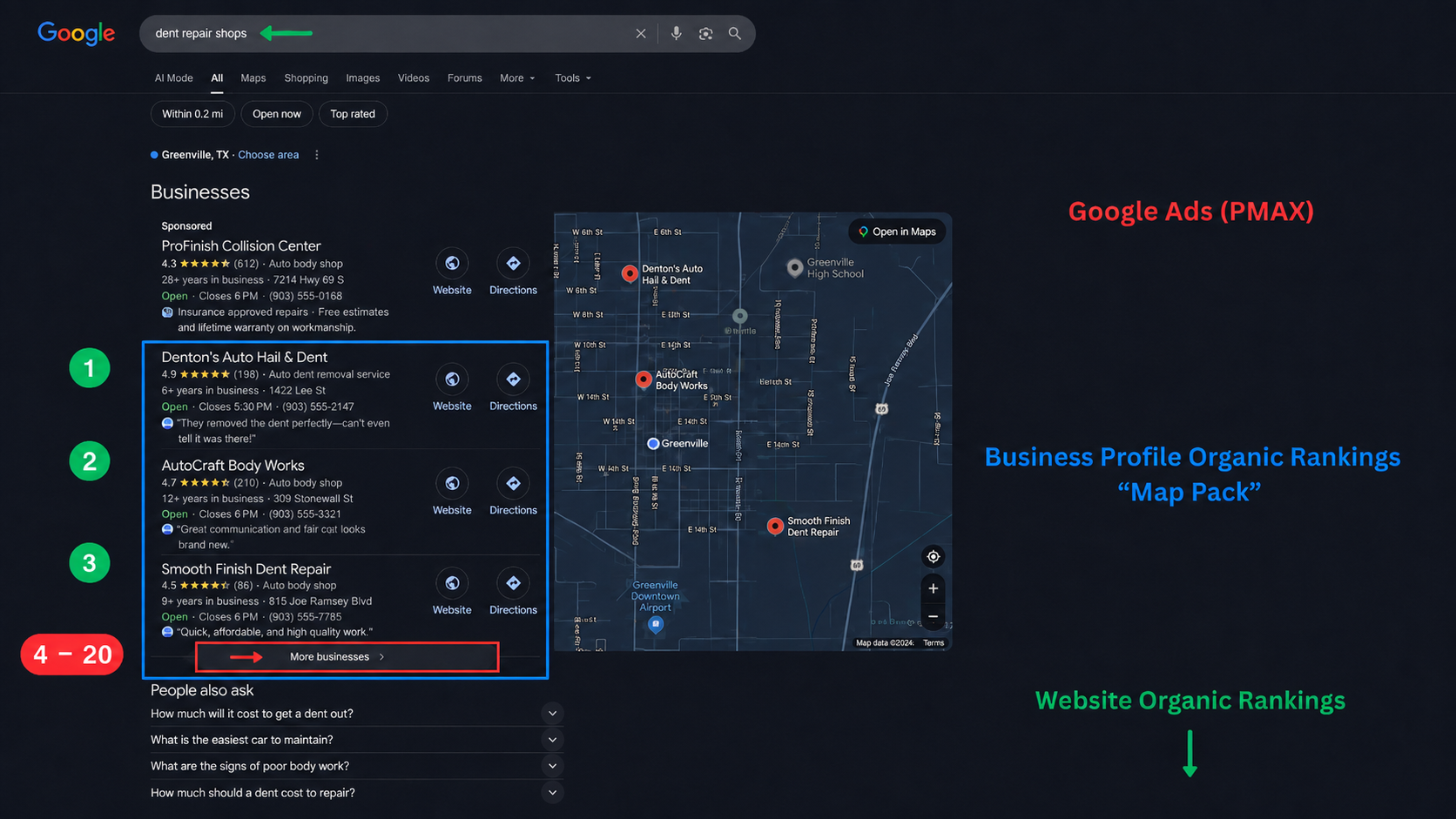
Every numbered point records the Google Business Profile's local ranking for the listed search term from that exact map location. This is separate from the website's standard organic ranking.

Why a Two-Mile Grid Can Be More Meaningful Here

For optometry, a wide geographic grid can quickly become less commercially useful because patients often have many closer choices for exams, glasses, and routine eye care. A tighter scan puts more emphasis on the radius where the practice is realistically competing for nearby demand.

1–3
Primary Map PackThese positions are the local listings most likely to be visible immediately without expanding the larger results list.
4+
Still Visible, but Below the Primary ThreeThe profile may still appear locally, but competing practices occupy the first Map Pack positions from that search point.
Why more competitors can appear without meaning SEO got worse

Local results are dynamic. A profile can hold or slightly improve its own ranking while Google introduces different nearby competitors at individual search points. That is one reason matched grids are more useful than relying on a single manual search.

Why the same business can rank differently for Eye Doctor and Vision Center

Those phrases do not necessarily represent the same intent. Google may weigh medical providers, optical retailers, and hybrid vision centers differently depending on the query, so each keyword should be measured as its own local search market.

Google Map Pack example explaining paid ads, top three Google Business Profile listings, lower map results and separate website organic rankings.
Map Pack example: Google Business Profile positions 1–3 are separate from paid Google Ads and from the website's standard organic rankings.
Section 03 · Website Organic Search

Google Search Console Website Growth

The Search Console screenshots show the other side of this account. While the Map Pack radius has been slower to expand, the website's organic search footprint continued growing strongly after roughly two years of ongoing content production.

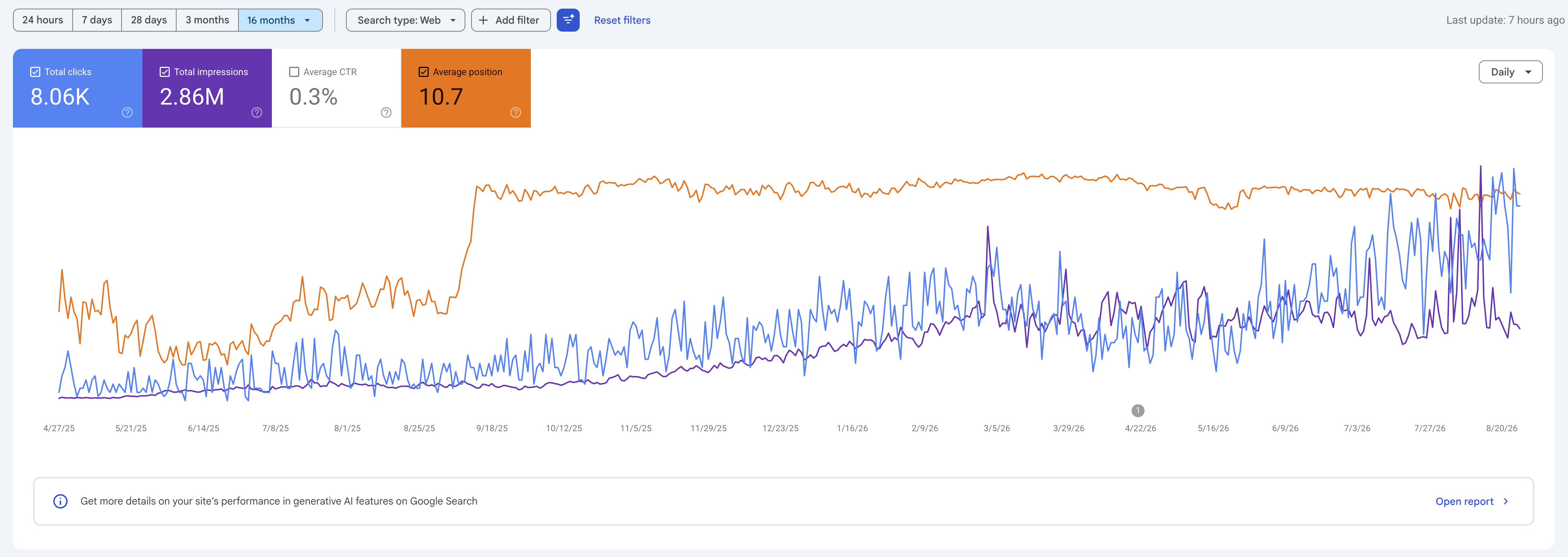
Sixteen-Month Organic Search View

The long-range Search Console screenshot provides context for how the site's clicks and impressions developed over time rather than treating the latest six-month jump as an isolated event.

Search Console View16 Mo.
Content Production~2 Years
Latest Traffic TrendRising
Avg. Position TrendImproving
Google Search Console · 16-Month Traffic Trend
Google Search Console sixteen-month organic search performance chart for a Houston optometry website.

Latest Six Months vs. Previous Six Months

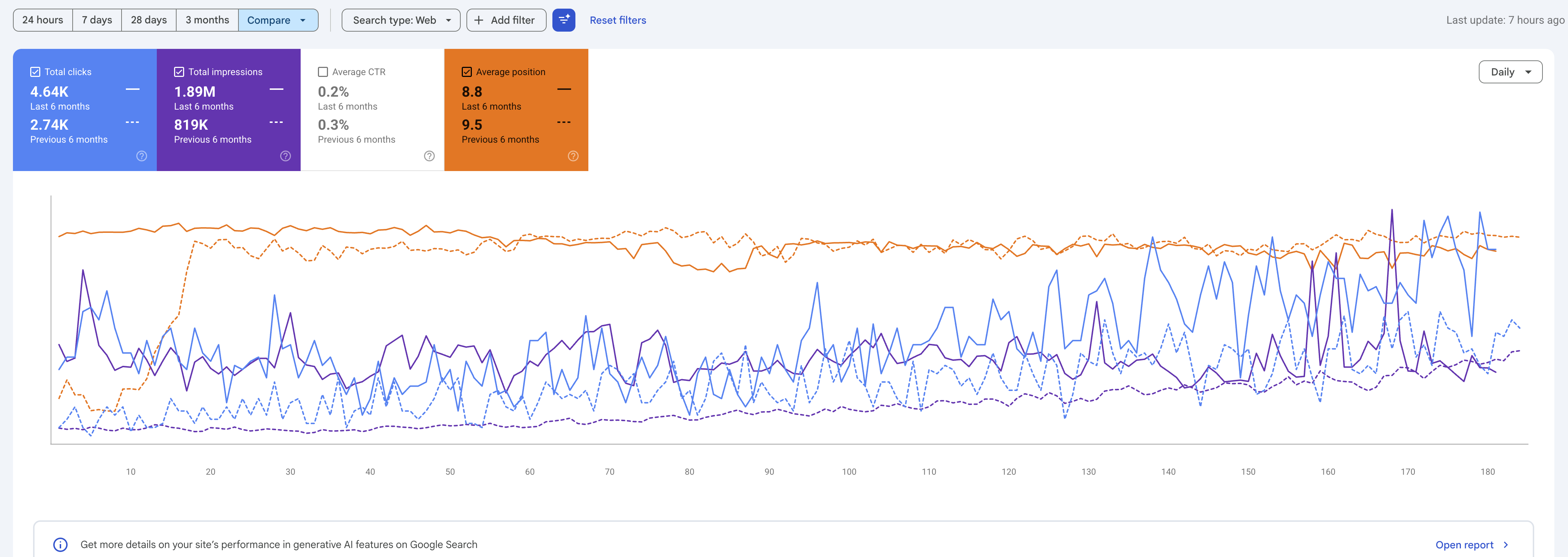
The latest comparison shows organic traffic continuing to more than double even after a long SEO runway. Average position also improved, which matters because the growth was not driven only by a larger volume of low-ranking impressions.

Organic Traffic>2×Latest six months vs. previous six months
Search VisibilityExpandedMore organic discovery across the comparison period
Average PositionImprovedRanking quality moved in the favorable direction
Google Search Console · Six-Month Traffic Comparison
Google Search Console comparison showing the latest six months of organic traffic versus the previous six months for an optometry website.

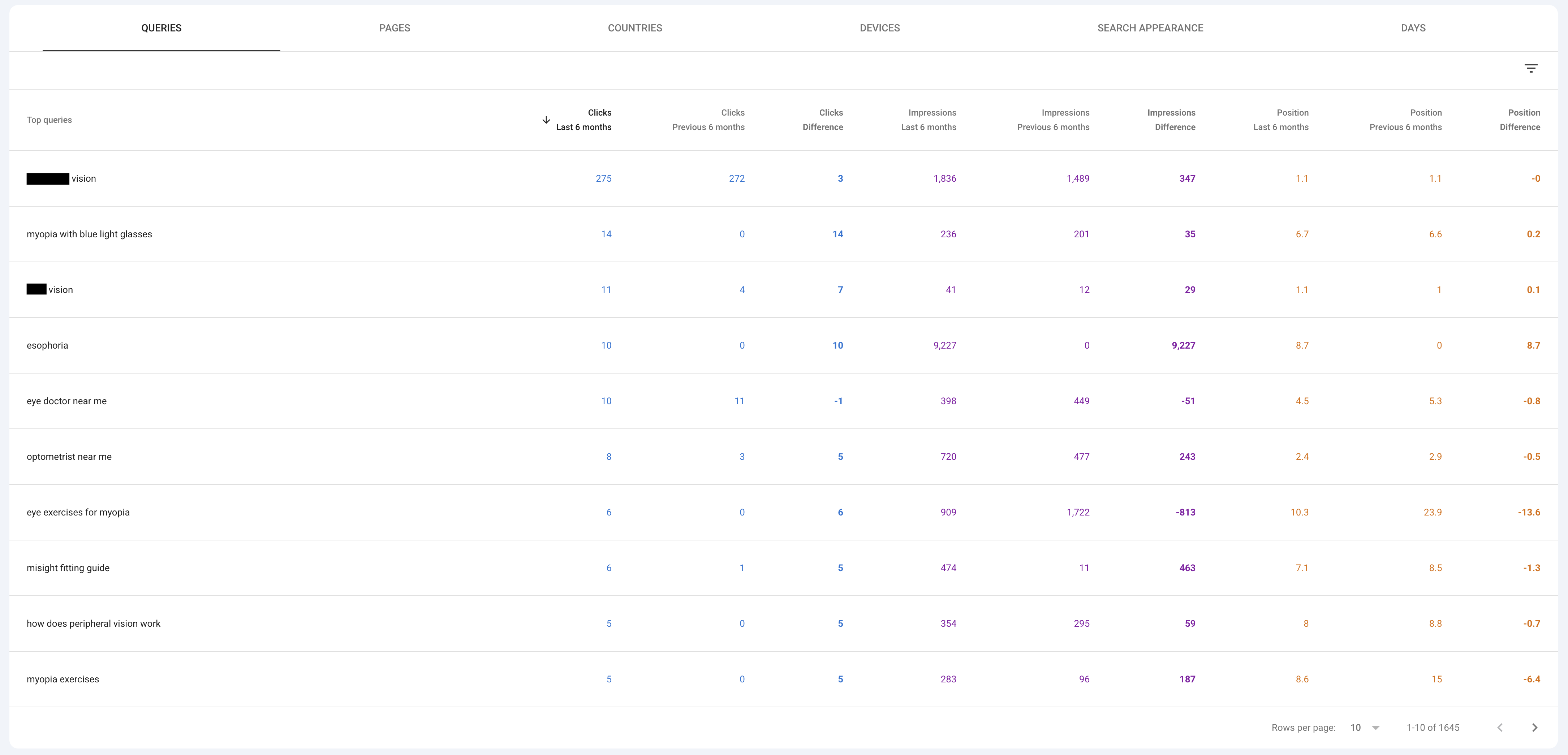
Query-Level Growth Across Eye-Care Searches

The query comparison helps show whether the website is gaining visibility across a broader set of eye-care searches rather than depending on one branded or local phrase. That matters for a mature content program because continued growth usually comes from accumulating many useful search entry points.

Google Search Console · Six-Month Query Comparison
Google Search Console query comparison showing clicks, impressions and ranking changes across optometry and eye-care searches.
Measurement note: Google Maps search grids and Google Search Console measure different organic surfaces. The grids describe where the Google Business Profile appears from physical search locations; Search Console describes how the website earns impressions and clicks across Google's standard organic results.
Houston Patient Geography

When a Two-Mile Map Radius Is a Business Reality, Not an SEO Failure

A roofing contractor, specialty consultant, and optometrist do not compete across geography the same way. This account is a useful reminder that the commercial radius of a service can shape the local ranking ceiling.

Routine Eye Care Is Highly Convenience-Sensitive

For an eye exam, glasses, or a routine optometry visit, many patients have several acceptable providers within a short drive. In a market as large and dense as Houston, that gives Google a substantial pool of nearby businesses to choose from at almost every search point.

That makes proximity unusually important. A practice can have a strong website, a well-developed profile, years of content, and good local relevance without dominating every point even a few miles away.

The Better Question Is Whether the Valuable Core Is Holding

For this type of business, an agency should not define success as turning an increasingly large map completely green. The more useful question is whether the practice remains competitive where nearby patients are most likely to convert and whether that core footprint is gradually strengthening.

That changes the reporting conversation from “Why are we not number one everywhere?” to “How much of the realistic patient market are we consistently reaching?”

Two Organic Search Speeds

The Map Pack Can Plateau While the Website Keeps Accelerating

This is the most important contrast in the report. Local profile expansion and website organic growth are both SEO outcomes, but they do not have to move at the same speed—or even face the same constraints.

GBP FootprintGradualA proximity-sensitive local market.
Website Traffic>2×Latest six-month period versus the prior period.
Content History2 YearsConsistent production rather than a short launch window.
Average PositionUpRanking quality continued improving with traffic.

A Google Business Profile is anchored to a physical location. Website pages are not limited in the same way. A useful article, service page, insurance page, condition page, or location-focused resource can earn impressions across a much broader set of searches without requiring the searcher to be standing within a narrow radius of the practice.

That is why agencies should resist compressing “local SEO” into one score. This client can have slower outward Map Pack expansion and still be experiencing exceptional organic growth overall because the website is capturing demand the profile alone cannot reach.

Long-Term Content Compounding

The Unusual Part Is Not Early Growth—It Is Still Doubling After Two Years

New websites often show dramatic percentage gains because the starting baseline is small. This account is more interesting because the latest six-month period is still more than doubling organic traffic after a long run of consistent content production.

Every Useful Page Creates Another Search Entry Point

Optometry has a wide content surface: exams, eyewear, contact lenses, insurance questions, symptoms, conditions, age groups, treatment topics, and local service intent. A mature content program can keep adding relevant entry points instead of relying on one homepage or a few core service pages.

Over time, the effect is cumulative. Older pages can retain rankings while newer pages begin earning their own impressions, giving the site more opportunities to appear across the full patient research journey.

Improving Average Position Makes the Traffic Gain More Meaningful

If traffic doubled only because the site appeared for a huge number of distant, low-ranking searches, the growth would be less impressive. The reported improvement in average position means ranking quality moved in the same favorable direction as traffic volume.

For an agency, that is a stronger long-term story: the site is not simply becoming larger; more of its organic footprint is moving into positions with a better chance of producing clicks.

Optometry Keyword Intent

Four Eye-Care Keywords Can Represent Four Different Local Competitor Pools

The comparison set is useful because “Eye Doctor,” “Eye Exam,” “Vision Center,” and “Optometrist” are related—but not interchangeable. Each phrase gives Google a slightly different interpretation of what the searcher wants.

01

Eye Doctor

A broad provider phrase that can overlap optometrists, ophthalmologists, and other eye-care providers depending on the market.

02

Eye Exam

A service-first search where appointment availability, convenience, insurance, and nearby options can matter heavily.

03

Vision Center

A phrase that may introduce optical retailers and multi-service vision locations into the local competitor set.

04

Optometrist

A professional-category search that can be highly local and especially sensitive to proximity in a dense metro.

For HighLevel SEO for optometrists, this distinction also informs page strategy. A site that treats every eye-care phrase as the same topic can miss the different questions and conversion paths behind each search. Search-grid differences can become useful input for deciding which services, topics, and local intent deserve stronger supporting content.

Agency Reporting Strategy

How to Report an SEO Account When One Channel Is Exploding and Another Is Mostly Holding

This type of account can be communicated poorly if the agency tries to force every graph into the same “everything went up” narrative. A better report explains why the two surfaces are behaving differently and what each one contributes.

1
Start With the ConstraintExplain that local profile rankings are proximity-sensitive and Houston offers patients many nearby eye-care choices.
2
Show the Matched GridsUse the same keywords and scan settings so changes in the local footprint can be discussed without changing the test.
3
Separate the Website StoryShow Search Console as its own organic asset, where geography and query breadth create a much larger growth ceiling.
4
Emphasize the Long RunTwo years of content history makes continued six-month acceleration more informative than a short-term launch spike.
5
Choose the Next Work From the GapProtect the strong local core while continuing to expand the website topics and searches that are still compounding.
Houston Optometry SEO FAQ

Questions Raised by This Local + Website Search Report

These answers focus on the unusual split in this account: a comparatively slow-moving local radius paired with a website that continues to accelerate after years of SEO work.

Why might an optometrist's Google Maps rankings stop expanding quickly after a certain distance?

Optometry is highly local. In a dense city such as Houston, searchers often have many closer options for routine eye care, exams, glasses, and contacts. Google can therefore place substantial weight on proximity once searches move farther from the practice.

Is a two-mile local search grid too small for SEO reporting?

Not necessarily. The useful scan size should reflect the market. A two-mile radius can be highly informative for a neighborhood-driven healthcare business because it concentrates the test on the area where nearby patients are most likely to choose the practice.

How can the website more than double traffic if Map Pack coverage changes only modestly?

The website and Google Business Profile are different organic surfaces. The profile is tied closely to physical location. Website pages can rank across many informational, service, condition, product, and local queries without requiring the searcher to be within the profile's strongest Map Pack radius.

Why does continued growth after two years of content production matter?

Large early percentage gains can happen when a website starts from a small baseline. Continued six-month acceleration after a long content history suggests the site is still adding and strengthening useful search entry points rather than relying only on an initial launch effect.

Why track Eye Doctor, Eye Exam, Vision Center, and Optometrist separately?

Google can interpret these phrases differently. They may surface different mixes of healthcare providers, optical retailers, and service-focused competitors. Tracking them separately prevents one keyword from being used as a stand-in for the entire eye-care market.

Can average website position improve while local grid rankings stay relatively stable?

Yes. Search Console average position summarizes website rankings across organic queries, while a local grid measures one Google Business Profile for one keyword from fixed physical points. They can move independently.

What should an agency optimize next in an account like this?

Protect the strong local core, keep improving the profile and supporting local signals, and continue expanding website content where Search Console shows compounding demand. The strongest next step is usually based on the constraint each surface actually has rather than forcing both to use the same tactic.

See What Changes When Local Reach and Website Reach Grow at Different Speeds

Browse the GHL Meets SEO case-study library for more examples of Google Business Profile, website, and paid-search reporting across different industries and market conditions.